Financial Impact of Carbon Risk: What Accountants Should Know

Nov 22, 2025
Understanding carbon risk is vital for accountants, affecting compliance, operational costs, and market reputation in a changing financial landscape.
Carbon risk is reshaping financial management, and accountants must act. Here's why:
£18 trillion threat: Climate-related risks could cost the global economy this much by 2050.
Regulations are tightening: Frameworks like SECR and ISSB demand detailed carbon disclosures, with non-compliance resulting in fines - up to 4% of annual revenue in the UK.
Profitability at stake: Companies with poor carbon practices face higher costs, supply chain disruptions, and reputational risks, while those prioritising carbon management can outperform competitors by 20%.
Investor and consumer shifts: 70% of investors now factor in environmental performance, and customers increasingly favour sustainable brands.
For accountants, this means moving beyond compliance. By leveraging tools like neoeco, tracking metrics (e.g., carbon intensity, emissions per revenue), and aligning with frameworks like ISSB, you can help businesses mitigate risks, reduce costs, and seize new opportunities. Carbon risk isn’t just a challenge - it’s a chance to redefine financial advisory services.
GHG 101 – Introduction to Carbon Accounting | The Accounting Matters Podcast
How Carbon Risk Creates Financial Impact
Carbon risk has a direct impact on company profit margins. When businesses fail to address these risks, the financial consequences can hit hard and fast. By breaking down how these risks translate into actual costs, accountants can help protect their clients' finances while also spotting areas for strategic improvement. Let’s dive into how regulatory pressures, operational challenges, and market perceptions create financial strain for businesses.
Regulatory Costs and Penalties
The rise of carbon regulations comes with hefty costs. In the UK, frameworks like the Streamlined Energy and Carbon Reporting (SECR) and Sustainability Reporting Standards (UK SRS) demand detailed carbon disclosures from qualifying companies. Falling short of compliance can lead to fines of up to 4% of annual revenue.
For example, in 2023, a major UK retailer was hit with a £2 million fine for failing to meet SECR requirements. The financial blow didn’t stop there - the company’s stock price dropped 5% after the announcement, showing how regulatory missteps can ripple into broader market consequences.
"The financial implications of carbon regulations are profound; companies must prioritise compliance to avoid penalties that can severely impact their profitability."
– Jane Doe, Sustainability Consultant, Green Finance Initiative
Beyond penalties, compliance itself requires investment. Companies need systems, training, and reporting infrastructure to meet these standards. Interestingly, businesses using advanced carbon accounting software report a 30% reduction in compliance-related costs compared to those relying on manual processes. This highlights how automation can make carbon management less expensive and more efficient.
But fines and compliance costs are only part of the story. Operational challenges add another layer of financial strain.
Operational and Supply Chain Disruptions
Carbon-related risks can drive up operational expenses significantly. Take energy price volatility, for instance - carbon pricing mechanisms can make energy costs unpredictable, which directly impacts manufacturing and logistics budgets. Companies with high carbon footprints may also face resource shortages, forcing them to either pay more for alternative suppliers or invest in new processes.
Supply chain issues add another challenge. As global regulations tighten, suppliers with poor carbon performance may face restrictions or higher costs, which are often passed down the chain. This leaves companies with two options: absorb the additional costs or find compliant suppliers, both of which can strain budgets.
Transitioning to low-carbon operations isn’t cheap either. Businesses often need to invest heavily in equipment upgrades, retraining staff, or adopting new technologies. While these changes can lead to long-term savings, they require careful financial planning to manage the upfront costs.
Reputational and Market Risks
Sustainability is no longer just a buzzword - it’s a key factor in how businesses are valued. Research indicates that 70% of investors now consider environmental performance when making investment decisions. Companies with poor carbon track records often face higher borrowing costs, making it more expensive to secure capital.
Consumer behaviour also plays a major role. In 2023, Unilever reported a 15% boost in brand loyalty from customers who prioritise sustainability, thanks to their efforts to cut carbon emissions and improve transparency. Proactively managing carbon risks isn’t just about staying compliant - it’s a way to gain a competitive edge.
Businesses with strong sustainability practices can outperform their competitors by up to 20% in stock performance. On the flip side, companies that neglect carbon risk management may struggle to win contracts, especially with larger corporations that enforce strict sustainability criteria for their supply chains.
"Understanding carbon risk is essential for accountants as it directly impacts a company's financial health and market reputation."
– Jane Doe, Sustainability Expert, EcoFinance Group
Reputation also plays a role in attracting and retaining talent. Younger workers increasingly favour employers with strong environmental commitments. Companies with poor carbon performance may find it harder to attract top talent, leading to higher recruitment and retention costs. For accountants, factoring in these reputational risks is vital when advising clients on their overall financial health.
Accountants play a key role in helping businesses navigate these risks. Tools like ISSB reporting frameworks enable companies to quantify and communicate their carbon risks effectively, turning compliance challenges into opportunities for stronger financial performance and improved market standing.
Common Problems Accountants Face with Carbon Risk
Accountants face unique challenges when it comes to measuring and reporting carbon risk, adding another layer of complexity to their financial responsibilities. These obstacles often prevent accurate sustainability reporting and can leave clients vulnerable to compliance risks or missed opportunities. Below, we explore some of the most pressing issues accountants encounter in managing carbon risk effectively.
Difficulty Measuring Emissions Accurately
While calculating Scope 1 emissions is relatively straightforward, Scope 2 and especially Scope 3 emissions remain a tough nut to crack. Why? It often boils down to incomplete or unreliable client data. Many businesses lack detailed records for things like energy usage, supplier activities, or employee travel. Instead of precise measurements, they rely on estimates, which naturally increases the margin for error in carbon footprint calculations.
The challenge doesn’t stop there. Manual conversion processes frequently introduce further inaccuracies. In fact, a survey found that 70% of companies struggle to align their carbon reporting with various standards, leading to confusion and errors in sustainability disclosures.
Scope 3 emissions, which often account for the largest portion of a company’s carbon footprint, add another layer of complexity. These indirect emissions require detailed data from suppliers, but most businesses simply don’t have this information readily available. The result? Accountants are left trying to piece together incomplete data while facing mounting pressure to deliver accurate reports.
Once data accuracy is addressed, accountants must navigate a minefield of reporting frameworks.
Inconsistent Reporting Standards
The absence of unified reporting standards makes carbon risk reporting a daunting task. Accountants must juggle several major frameworks, including the Greenhouse Gas Protocol (GHGP), ISO 14064, and the UK's Streamlined Energy and Carbon Reporting (SECR). Each framework has its own methodology and requirements, creating discrepancies and confusion.
GHGP takes a broad approach to emissions accounting, covering direct and indirect emissions comprehensively.
ISO 14064 offers a structured methodology for quantifying greenhouse gas emissions.
SECR focuses on energy use and carbon emissions for UK-based companies.
These overlapping frameworks often lead to conflicting results. For example, emissions calculated under GHGP might differ significantly from those reported under SECR, even for the same company. This inconsistency becomes even more problematic for businesses operating across multiple jurisdictions, where they may need to comply with several frameworks simultaneously.
"The lack of standardised reporting frameworks creates significant hurdles for accountants, making it challenging to prepare consistent and reliable sustainability reports." - Sustainability Expert, Workiva
To complicate matters further, regulations are constantly evolving. With frameworks like ISSB reporting gaining traction, accountants must stay on top of changing requirements to ensure compliance. For firms with limited resources, this fragmentation adds considerable strain.
Limited Resources for Sustainability Work
Most accounting firms lack the specialised expertise needed for effective carbon risk management. Training staff in sustainability practices and carbon accounting methods requires both time and money - resources that smaller firms often find hard to justify.
Budget constraints pose another issue. Many firms hesitate to invest in sustainability services because the financial benefits aren’t immediately apparent. This creates a frustrating cycle: firms need resources to build expertise, but they can’t secure those resources without first proving the value of their services.
Without dedicated sustainability professionals, general accountants are often tasked with handling complex carbon calculations. This not only leads to inefficiencies but also increases the risk of errors and compliance issues.
Technology gaps exacerbate the problem. Many firms lack the tools needed to measure and report emissions accurately. Traditional manual processes, while sufficient for standard accounting, become unwieldy and error-prone when applied to sustainability reporting.
Thankfully, there’s light at the end of the tunnel. Integrated sustainability management software is starting to bridge the gap. These tools automate much of the data collection and calculation process, making it easier for firms to manage carbon risk without overwhelming their resources. By freeing up time spent on manual tasks, accountants can shift their focus to analysis and advisory services, helping clients make informed decisions about sustainability.
The bottom line? With the right tools and strategies, even smaller firms can tackle carbon risk management head-on. By improving metrics and embracing automation, accountants can integrate sustainability into financial decision-making, offering clients better protection and unlocking new opportunities for growth.
Metrics and Tools for Carbon Risk Management
For accountants aiming to manage carbon risk effectively, having the right metrics and tools is crucial. With the right approach, sustainability reporting can shift from being a compliance chore to a strategic opportunity that benefits both businesses and their clients.
Key Carbon Risk Metrics to Track
One of the most important metrics to monitor is carbon intensity. This measures the amount of carbon emissions produced for every unit of output, whether that's per unit of revenue, product, or employee. It’s a practical way to evaluate operational efficiency in terms of emissions, helping businesses set achievable reduction targets and track progress over time.
Another useful measure is emissions per revenue, which links a company’s carbon footprint to its financial performance. For instance, if a company generates £1 million in revenue but emits 100 tonnes of CO₂, its emissions intensity is 0.1 tonnes per £1,000 of revenue. This metric is particularly valuable for tracking performance trends and benchmarking against industry standards.
The cost of carbon reduction is another critical metric, focusing on the financial investment needed to achieve specific emissions cuts. By comparing the cost per tonne of CO₂ avoided across various initiatives, accountants can identify the most cost-effective strategies, ensuring the best return on investment for sustainability efforts.
Tracking these metrics consistently - monthly or quarterly - allows accountants to spot trends, measure progress, and provide actionable insights. Over time, these measurements form the foundation for robust and reliable sustainability reporting.
Reliable Reporting Frameworks
Standardised frameworks are vital for consistent and credible carbon risk reporting. One of the most widely recognised is the Greenhouse Gas Protocol (GHGP), which provides detailed guidance for measuring and reporting emissions across all three scopes. Its standardised approach ensures comparability between organisations and over time.
Another key framework is ISO 14064, which offers a structured method for quantifying greenhouse gas emissions. With its built-in verification processes, it’s particularly useful for organisations seeking third-party assurance, as it includes clear documentation and audit requirements.
For UK companies, the Streamlined Energy and Carbon Reporting (SECR) framework sets mandatory standards for reporting energy use and carbon emissions. It’s especially relevant for businesses with larger operational footprints. Meanwhile, the UK Sustainability Reporting Standard (UK SRS) is emerging as a comprehensive framework that aligns with international standards while addressing UK-specific regulations. Understanding how ISSB reporting integrates into financial strategies is becoming increasingly important as these frameworks evolve.
Choosing the right framework often depends on the organisation’s needs. Many businesses benefit from using GHGP as a primary methodology while ensuring compliance with national frameworks like SECR or UK SRS. Leveraging technology can further streamline reporting, improving both efficiency and accuracy.
Automation Tools like neoeco
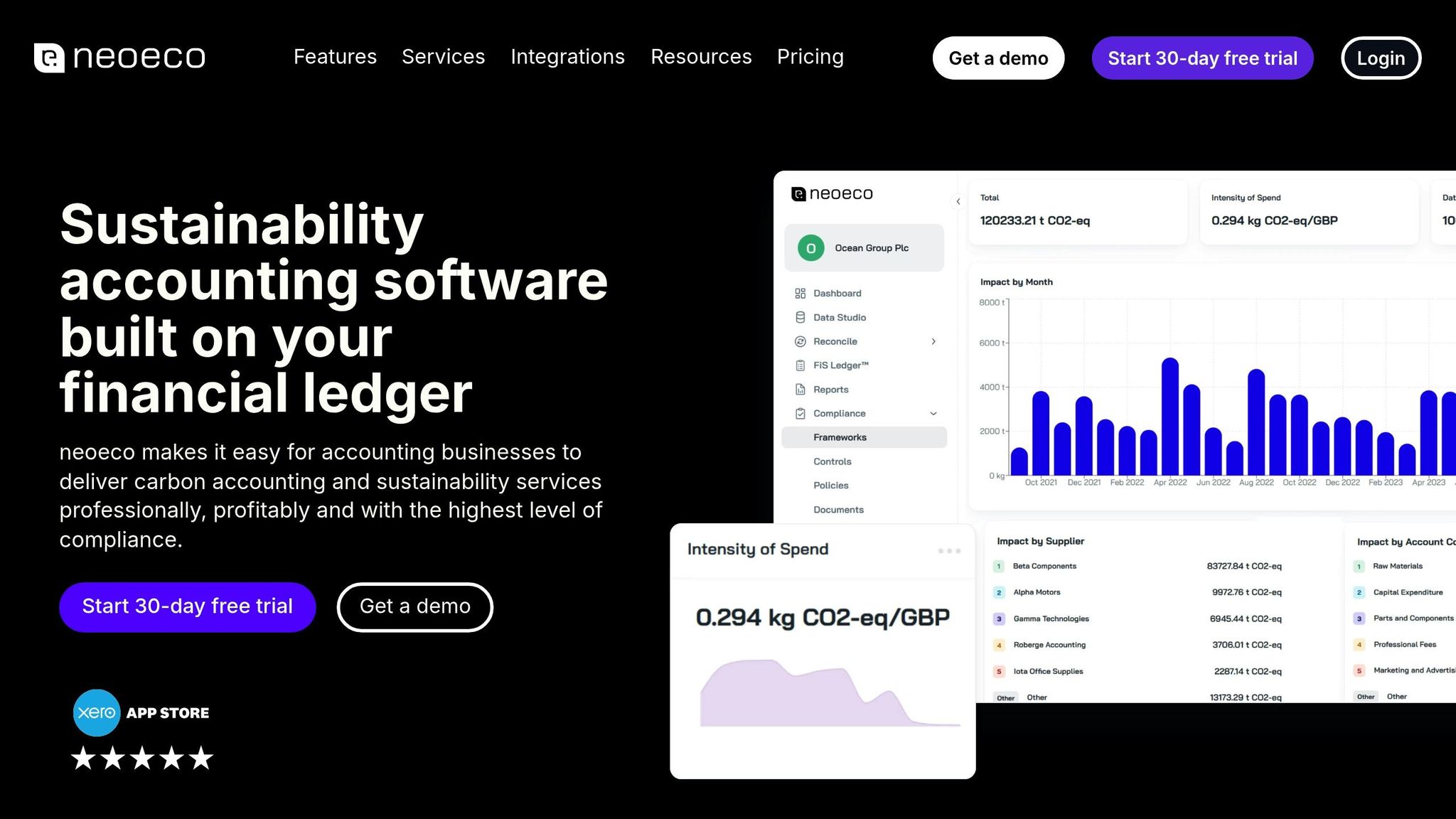
Managing carbon data manually can be time-consuming and prone to errors. Tools like neoeco simplify the process by integrating directly with financial systems such as Xero, Sage, and QuickBooks, eliminating the need for separate data entry.
The platform’s smart transaction mapping links ledger entries to Scope 1, 2, and 3 emissions categories using methodologies from GHGP and ISO 14064. This automation ensures accurate calculations, freeing accountants to focus on providing analysis and advice.
With real-time dashboards, accountants gain instant visibility into emissions trends, intensity metrics, and progress towards targets. These live updates allow for timely insights, eliminating the need to wait for month-end reports.
Pre-built reports for frameworks like SECR, UK SRS, and ASRS 2 are generated in minutes, complete with the documentation and audit trails needed for compliance. This feature significantly reduces the administrative workload for accounting teams.
The platform also includes audit-ready controls, which use a live checklist to track completed tasks, outstanding items, and those ready for review. This functionality is especially helpful during busy reporting periods, ensuring nothing is overlooked.
Additionally, the Policy & Evidence Hub securely stores all supporting documentation, making it easy to access evidence for audits or assurance reviews under ISO 14064 or ISSA 5000. This centralised system eliminates the hassle of searching through multiple platforms for specific documents.
For firms hesitant about implementation, neoeco offers a 30-day free trial with onboarding support. This allows teams to explore the platform’s capabilities risk-free, while the flexible pricing model lets firms scale their sustainability services at their own pace.
How to Include Carbon Risk in Financial Decisions
With reliable metrics and reporting frameworks in place, integrating carbon risk into financial decisions becomes a logical progression. This step shifts sustainability from being merely a compliance task to becoming a strategic priority. For accountants, this means expanding their advisory expertise to help clients navigate a business world increasingly focused on carbon-conscious practices, all while safeguarding financial performance.
Adding Carbon Risk to Business Planning
Incorporating carbon risk into long-term business planning is as essential as financial analysis. This involves assessing how factors like carbon pricing, regulatory changes, and market trends could impact profitability over the next 5–10 years.
Investment decision frameworks should also account for carbon considerations. For example, when evaluating new equipment, facility expansions, or supply chain adjustments, businesses should factor in energy efficiency and potential carbon taxes.
Capital allocation decisions need to reflect emissions intensity. Companies with higher emissions may need to reserve funds for decarbonisation projects, which could reduce the capital available for growth. Accountants can model various scenarios to show how different levels of sustainability investment might influence both emissions reductions and financial returns.
Budget planning should include projections for carbon costs. As carbon pricing mechanisms expand, businesses must account for direct costs, such as carbon trading schemes, and indirect costs, like supplier price adjustments, when setting annual budgets.
Routine financial assessments should integrate carbon risk analysis. With ISSB reporting set to become mandatory, having these processes in place is essential for compliance. This also lays the groundwork for robust scenario analyses that evaluate future financial impacts.
Scenario Analysis and Stress Testing
Scenario analysis provides clarity on how carbon risks might affect a business under various conditions. Instead of aiming to predict the future, this approach evaluates resilience against a range of possibilities.
Carbon pricing scenarios: Accountants can model different carbon price levels to determine their impact on operating costs and profit margins. For instance, a logistics company with a large fleet could assess how higher carbon prices might require operational changes.
Regulatory scenarios: These examine how new rules, such as stricter emissions limits or renewable energy mandates, could influence operations. Each scenario quantifies compliance costs and necessary adjustments.
Market demand scenarios: These focus on how shifting customer preferences for low-carbon products and services might impact revenue. For example, a manufacturer might explore how quickly demand could shift towards lower-emission products and the investment needed to meet this demand.
Supply chain disruption scenarios: These evaluate how carbon-related changes in supplier costs or availability might affect operations. As climate-related disruptions increase, understanding exposure to these risks becomes critical.
By combining these factors - rising carbon prices, stricter regulations, and changing market demand - businesses can model integrated scenarios for a comprehensive view of potential impacts.
Clear Communication with Stakeholders
Effectively communicating carbon risk analysis requires translating complex sustainability data into clear, actionable insights for stakeholders. The way this information is presented often determines its impact.
Using intuitive reporting tools can help create professional reports that include charts, figures, and commentary. Customising these reports with firm branding adds a polished touch.
Real-time transparency is key to building trust. Live dashboards provide stakeholders with up-to-date insights into carbon risk performance, enabling boards and management teams to stay informed without waiting for periodic updates.
Verified data integrity ensures credibility. Sharing accurate, complete, and current carbon data, while clearly explaining methodologies like those from GHGP, SECR, or UK SRS, reinforces trust.
Audit-ready documentation simplifies external reviews. Providing auditors with direct access to detailed reports and supporting evidence enhances transparency and ensures that sustainability performance is both verifiable and easy to review.
Framework compliance ensures consistency. Aligning with global and local reporting standards allows stakeholders to benchmark performance over time and across industries.
Ultimately, the goal is to go beyond raw emissions figures. Accountants should explain how these figures affect future profitability, competitive positioning, and strategic planning. This approach highlights the importance of robust carbon risk management and why it deserves serious attention and investment.
Conclusion: Getting Ready for Carbon-Focused Finance
The financial world is moving quickly towards prioritising carbon accountability, and accountants who adapt now will position themselves as leaders in this changing landscape. Carbon risk is no longer an abstract concept - it directly affects everything from operational expenses to investment strategies.
Using the metrics and tools discussed earlier, it’s clear that carbon risk has far-reaching financial implications. Regulatory penalties, supply chain challenges, and shifting market demands highlight the tangible nature of this risk. Non-compliance can be costly, but proactive management of carbon risks opens doors to cost efficiencies and a competitive edge. For accountants, this shift presents both a challenge and an opportunity to offer expanded services that deliver meaningful value to their clients.
The barriers to effective sustainability reporting are becoming a thing of the past. Advanced automation tools like neoeco have replaced outdated, spreadsheet-heavy methods with efficient, audit-ready solutions. These innovations enable accounting firms to offer carbon accounting and sustainability services with little disruption or extensive retraining.
The urgency to act is growing. Mandatory frameworks such as ISSB, SECR, and UK SRS are already reshaping how financial risks are managed. Firms that develop robust carbon risk management systems now will be better equipped to meet evolving client expectations. Success in this area isn’t just about knowing the regulations - it’s about turning carbon data into actionable financial insights, effectively communicating risks to stakeholders, and embedding sustainability into business strategies. When accountants can clearly show how carbon risks impact profitability, market position, and long-term resilience, they shift from being compliance experts to becoming trusted strategic advisors.
Firms that view sustainability as an opportunity are already laying the groundwork to excel in this carbon-conscious financial era. For those ready to embrace this transformation, the tools, frameworks, and market demand are already in place to support profitable growth in this critical service area.
Understanding ISSB reporting will be a key step for accountants aiming to future-proof their practices and offer comprehensive carbon risk management solutions to their clients.
FAQs
What are the best practices for accountants to measure and report Scope 3 emissions despite challenges with data availability?
Measuring and reporting Scope 3 emissions can be tricky, largely because reliable and complete data isn’t always easy to come by. But there are practical steps accountants can take to navigate these obstacles and streamline the process.
A great starting point is working closely with suppliers and stakeholders to gather the necessary data. This approach encourages transparency and collaboration, making the process smoother and more effective. Another useful strategy is to use sustainability accounting tools like neoeco. These tools integrate directly with financial ledgers, automatically linking transactions to recognised emissions categories such as GHGP and ISO 14064. This not only reduces manual work but also ensures compliance with frameworks like SECR and UK SRS.
It’s also important to establish clear reporting boundaries and focus on the most material emission categories. By relying on finance-grade tools and precise metrics, accountants can create audit-ready reports that align sustainability efforts with financial objectives.
What are the main advantages of using automation tools like neoeco for managing carbon risks in accounting?
Automation tools like neoeco make managing carbon risks much easier by pulling precise, finance-grade carbon data straight from financial records. This removes the hassle of dealing with manual spreadsheets and conversions, while ensuring compliance with recognised standards like GHGP, ISO 14064, SECR, and UK SRS.
For accounting firms, neoeco enhances the way they deliver sustainability and carbon accounting services. It simplifies sustainability reporting, provides audit-ready reports, and helps firms support their clients' future needs - all while staying profitable and confidently meeting compliance requirements.
How can businesses factor carbon risk into their financial planning and investment strategies?
In today’s shifting regulatory and environmental landscape, factoring carbon risk into financial planning has become crucial for businesses that want to stay resilient and competitive. Companies need to examine their reliance on carbon-heavy activities, anticipate future costs such as carbon taxes, and evaluate how their supply chains and operations might be impacted.
Accountants have a pivotal role here. By incorporating carbon metrics into financial analysis, they can offer valuable insights. Using tools aligned with established frameworks like the GHGP and ISO 14064 can simplify this process. For instance, platforms like neoeco make it easier by linking financial transactions to emissions categories, providing precise, audit-ready carbon data. This not only ensures regulatory compliance but also supports businesses in making smarter, sustainable investments that align with their long-term objectives.