How APIs Simplify Scope 3 Data Collection

Jan 5, 2026
Use APIs to automate Scope 3 data collection—integrating ERPs and supplier systems to deliver real‑time, audit‑ready emissions data and cut manual effort.
Scope 3 emissions, which account for up to 90% of a company’s carbon footprint, are notoriously hard to measure due to their indirect nature and reliance on data from suppliers across complex supply chains. Manual methods like spreadsheets and surveys are not only time-consuming but also prone to errors and inconsistencies.
APIs solve these challenges by automating data collection, directly integrating with systems like ERPs, accounting platforms, and supplier tools. This approach enables real-time data exchange, reduces manual workload by up to 99%, and ensures more accurate, audit-ready reporting. By pulling precise transaction data and mapping it to recognised emissions standards, APIs provide a scalable and efficient solution for handling Scope 3 data.
Key takeaways:
Manual methods: Inefficient, error-prone, and reliant on estimates.
APIs: Automate data collection, integrate with existing systems, and ensure compliance with frameworks like GHGP and ISO 14064.
Benefits: Real-time insights, improved accuracy, and reduced administrative burden.
For organisations and accounting firms, API-driven tools like neoeco streamline Scope 3 reporting, replacing outdated processes with secure, automated systems.
Why Scope 3 Data Collection Is Difficult
Multi-Tier Supply Chains Create Data Complexity
Supply chains are intricate, multi-layered networks, making it challenging for organisations to see beyond their immediate partners. Often, distant suppliers use varying formats, measurement units, and standards, which fragments data and complicates manual collection efforts.
In fact, in nearly two-thirds of all economic sectors, Scope 3 emissions account for over 75% of the total carbon footprint. Yet, because most companies have limited control over these emissions, they frequently turn to Environmentally Extended Input-Output (EEIO) models that rely on spending data. While these industry averages provide a baseline, they fail to reflect actual progress, such as when suppliers invest in cleaner technologies.
This inherent complexity amplifies the likelihood of errors in manual data collection, as outlined below.
Problems with Manual Data Collection
Relying on manual methods like spreadsheets, emails, or surveys introduces a host of issues, from transcription errors and accidental deletions to inconsistent reporting formats. When data is scattered across emails or isolated in multiple spreadsheets, validating or consolidating it into a single, audit-ready source becomes nearly impossible.
Smaller suppliers face additional hurdles. Many lack the resources or expertise to provide detailed carbon data. For some, the internal costs of carbon accounting can consume between 1% (for large companies) and 3% (for smaller firms) of total revenues. On top of this, 57% of executives express concerns about sharing sensitive data, fearing it could expose trade secrets or supplier networks. Suppliers, too, worry that disclosing product-level emissions might lead to reverse engineering of their processes. This reluctance often forces organisations to rely on broad industry averages, perpetuating poor data quality.
Manual processes also struggle to keep up with the scale and complexity of global supply chains. Fragmented data and inconsistent reporting contribute to what’s been termed "measurement burnout", highlighting the growing need for automated systems to manage Scope 3 emissions effectively.
How APIs Enable Automated Data Exchange
What APIs Are and How They Work
An API, or Application Programming Interface, acts as a digital link that facilitates automated and secure data sharing between software systems. In the context of sustainability reporting, APIs allow platforms to directly interact with supplier systems, ERPs, and procurement tools, removing the need for manual data entry or file exchanges.
ESG APIs often utilise RESTful interfaces and standardised JSON formats. Instead of relying on spreadsheets or manually inputting data from invoices, APIs fetch information directly from the source system and transfer it securely using protocols like OAuth 2.0 and HTTPS encryption.
To streamline implementation, APIs frequently adhere to open standards such as OpenAPI and Swagger. These standards ensure clear documentation and make it easier to establish connections between different systems. Each data point can be tagged with a unique ID at its source, providing a reliable audit trail - an essential feature for meeting regulatory requirements like those outlined in the CSRD framework.
This seamless connectivity enables precise emissions data to be retrieved directly from the original systems, offering a reliable foundation for sustainability reporting.
Using APIs to Collect Emissions Data
APIs do more than just provide a technical backbone - they transform how emissions data is collected and managed.
By pulling primary vs secondary data, such as metre readings, utility bills, and production records, directly from supplier systems, APIs ensure that Scope 3 reporting is based on actual activities rather than estimates. This eliminates the inefficiencies and inaccuracies often associated with manual data collection.
APIs integrate with a variety of existing tools, including ERPs, procurement platforms, inventory management systems, and supplier portals. This creates a centralised, reliable source of sustainability data, breaking down silos and ensuring that all metrics are consistent and accessible. ESG consultant Johannes Fiegenbaum highlights the efficiency of modern ESG APIs:
"modern ESG APIs connect directly to over 230+ business applications, creating a unified source of truth for sustainability metrics - crucial for effective ESG reporting"
Another advantage of APIs is their ability to deliver data in real time. This shifts sustainability platforms from relying on periodic updates - such as quarterly or annual reports - to enabling continuous monitoring. This is particularly significant given that 57% of S&P 500 companies identify data integration and automation as their top sustainability challenges. Moreover, API integrations can drastically cut the time required for Scope 3 data collection - by as much as 99%.
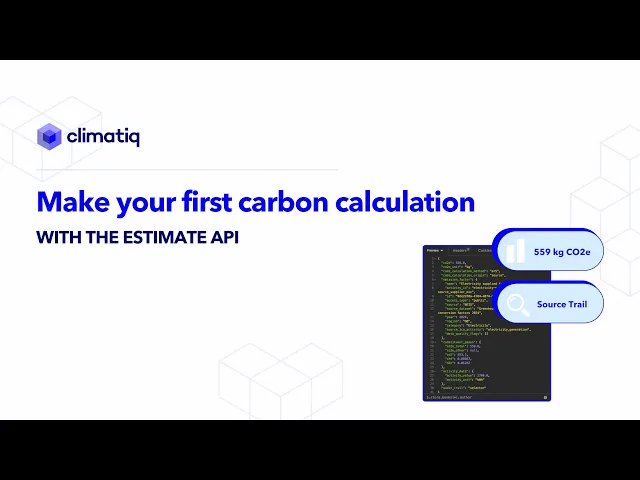
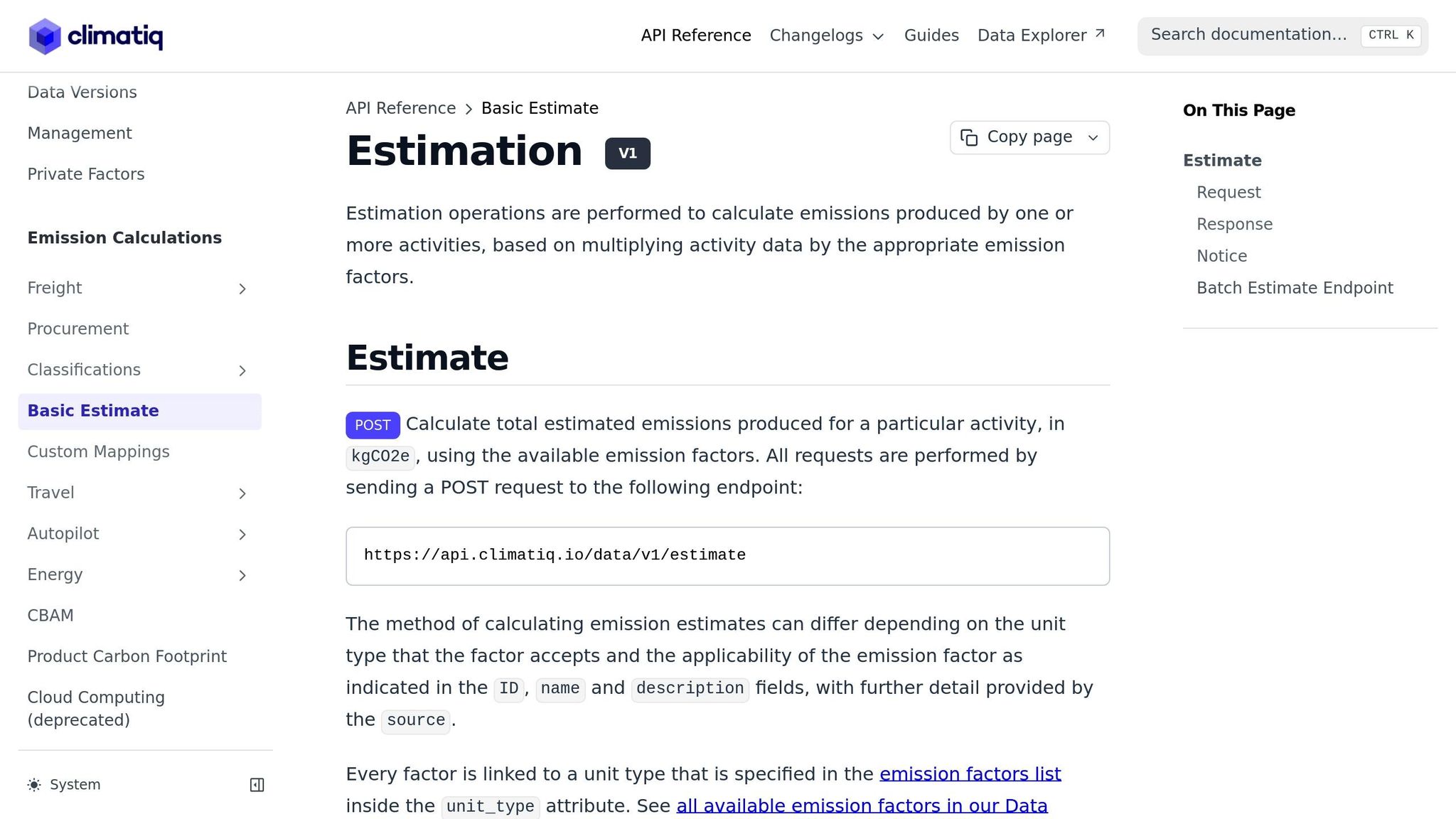
Make your first carbon calculation with Climatiq's Estimate API
How to Set Up API-Driven Scope 3 Data Collection
3-Step Process for Setting Up API-Driven Scope 3 Data Collection
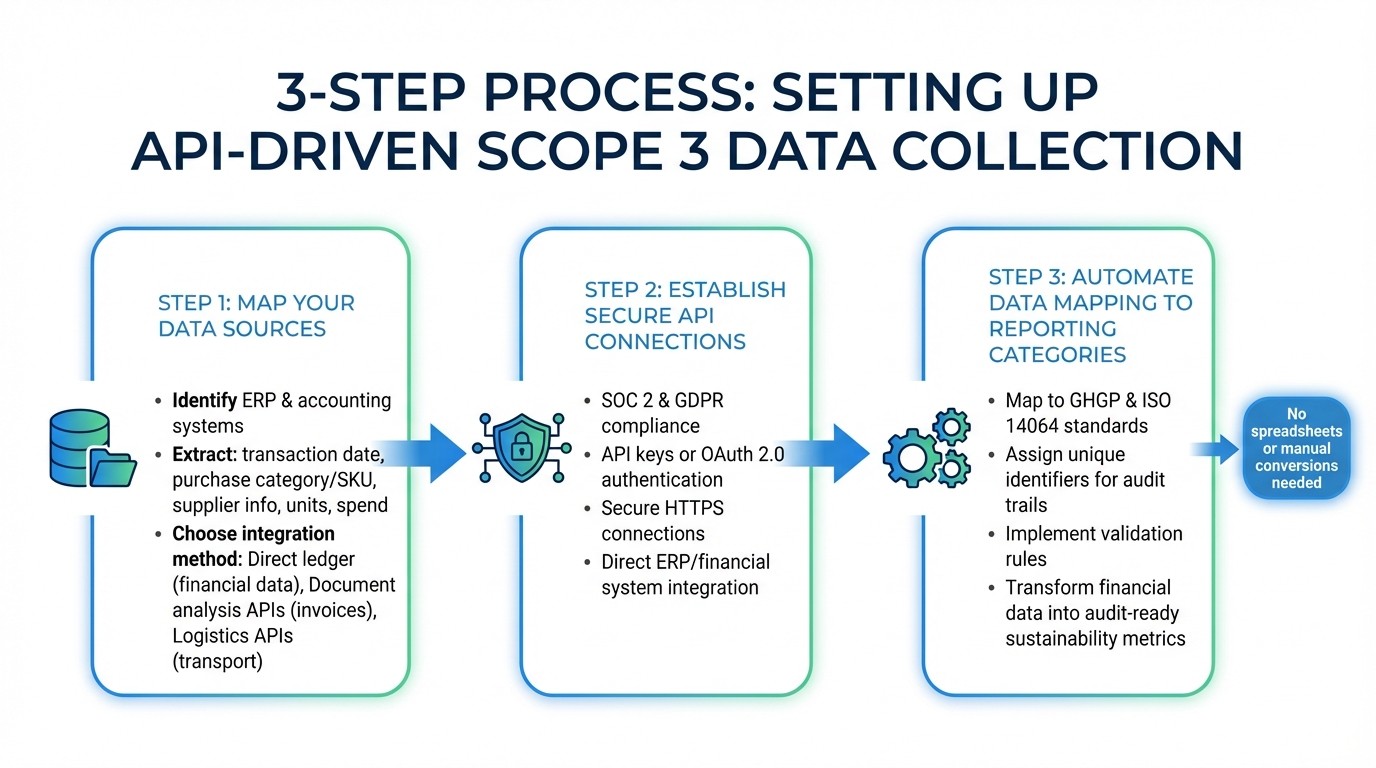
Step 1: Map Your Data Sources
Start by identifying where your procurement and transaction data is stored. These are usually systems like ERPs or accounting software. These platforms already contain the financial transactions that are the foundation for calculating your Scope 3 emissions.
You’ll need to extract critical details such as the transaction date, purchase category or SKU, supplier information (name and location), units, and spend. These data points are essential for aligning transactions with emission factors.
Next, determine the best integration method for your data. For structured financial transactions, direct ledger integration works well. For unstructured invoices, document analysis APIs are ideal, while logistics APIs are best suited for transport emissions. Accurate data mapping is key to unlocking supplier-specific emission factors. Once you’ve mapped your data sources, the next step is setting up secure API connections.
Step 2: Establish Secure API Connections
When dealing with sensitive financial and emissions data, security is non-negotiable. Make sure the platform you choose complies with SOC 2 and GDPR standards to safeguard data and ensure confidentiality. As neoeco highlights:
"neoeco is fully SOC 2 and GDPR compliant, ensuring your data is secured and protected."
To keep data exchanges secure, use authentication methods like API keys or OAuth 2.0, which restrict access to authorised systems only. All data transfers should occur over secure HTTPS connections to prevent any unauthorised interception. Direct integrations with your ERP and financial systems are preferable, as they can automatically pull transaction-level data. This eliminates the hassle of manual uploads or sharing spreadsheets.
Step 3: Automate Data Mapping to Reporting Categories
With your API connections in place, the next step is automating the mapping of data to recognised standards such as GHG Protocol compliance and ISO 14064. Smart matching engines can link your transactions to emission factors and ISSB reporting categories.
Each data point should be assigned a unique identifier to create a clear audit trail. Implement validation rules to detect anomalies or missing information. This process transforms raw financial data into sustainability metrics that are ready for audits - no spreadsheets or manual conversions needed.
Advantages of Using APIs for Scope 3 Data Collection
More Accurate and Reliable Data
APIs pull data directly from trusted sources like ERPs, HR platforms, and utility metres, significantly reducing errors caused by manual transcription or guesswork. Since APIs access verified financial records, you're working with the exact data that auditors rely on.
Another key benefit is standardisation. APIs can harmonise data across currencies, distances, and temperatures, which is especially useful for global supply chains. This ensures consistency that manual surveys simply can't achieve. Instead of relying on broad estimates based on spending, APIs allow you to gather specific, activity-based data straight from suppliers. This creates a foundation for consistent and reliable data streams.
Access to Real-Time Data
While traditional reporting happens periodically, APIs enable continuous data updates. This means you no longer have to wait for batch processing or chase suppliers for manual submissions. With increasing disclosure requirements, companies need systems that deliver real-time insights. Modern RESTful APIs using JSON formats integrate easily into existing workflows, providing ongoing visibility into your Scope 3 emissions rather than relying on outdated snapshots. Real-time data not only improves accuracy but also makes scaling across complex networks much smoother.
Easier to Scale Across Complex Supply Chains
Scaling manual data collection is nearly impossible. Take the example of Voltus, an energy platform that switched from manual data processing to automated extraction in 2025. What previously took 48 hours to complete was reduced to just 1.5 minutes. This change allowed the company to process millions of documents, saving over 11,000 person-hours.
APIs offer a standardised way for various software systems - like ERPs, CRMs, and accounting tools - to communicate, eliminating the format inconsistencies that often arise with manual surveys. When new suppliers join your network, they can be integrated seamlessly without affecting system performance. Automation can slash processing costs by up to 80% compared to manual methods, and API integrations can cut the time required for Scope 3 data collection by as much as 99%.
neoeco: Automating Scope 3 Reporting for Accounting Firms
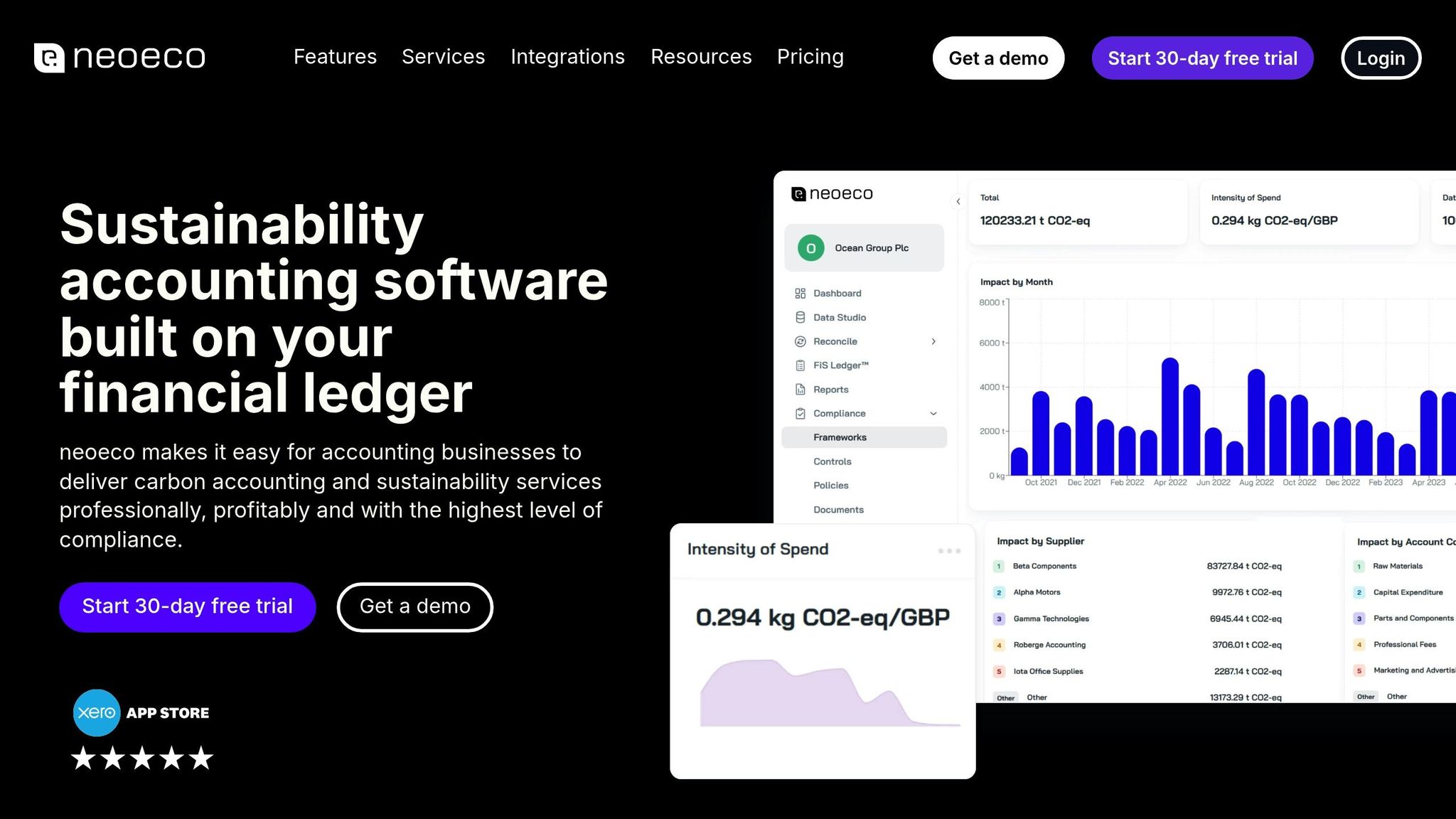
neoeco tackles the complexity of supply chain data with API-driven solutions designed specifically for accounting firms.
Connecting Financial and Sustainability Data
neoeco integrates directly with popular accounting systems like Xero, Sage, and QuickBooks, using a method called Financially-integrated Sustainability Management (FiSM). By pulling transaction data directly through APIs, neoeco eliminates the need for separate data collection systems for carbon reporting. Transactions are automatically matched to the proper carbon categories under frameworks like GHGP and ISO 14064.
The platform is built with security in mind, adhering to SOC 2 and GDPR standards, so client data is safe while being processed in real-time. With live dashboards, you can monitor Scope 3 emissions as they happen - no waiting for month-end reconciliations. This integration ensures accurate, automated compliance mapping without the hassle.
Automatic Mapping to Compliance Frameworks
neoeco’s smart matching feature streamlines compliance by automatically assigning transactions to emissions categories under frameworks such as SECR, UK SRS, or ASRS 2 for Australian clients. The system updates itself as these frameworks evolve, so your firm remains compliant without the need for constant updates or retraining.
For data that can't be accessed via APIs - like activity-based emissions factors from specific suppliers or utility bills from smaller providers - neoeco allows you to upload additional data. The platform then cleans and integrates this information with your existing ledger data, ensuring consistency and accuracy.
Replacing Spreadsheets with Automated Reporting
With its secure integration and precise mapping, neoeco replaces time-consuming manual processes. Research shows sustainability teams spend as much as 70% of their time on tasks like data collection and verification. neoeco eliminates this inefficiency by generating audit-ready, finance-grade reports. You can even customise these reports with your firm’s branding and provide auditors with direct platform access, cutting down on endless email threads and spreadsheet revisions.
neoeco offers a 30-day free trial, with monthly subscriptions and no long-term commitments. Payments are securely handled via Stripe, ensuring top-tier compliance and peace of mind.
Conclusion
APIs are transforming the way Scope 3 data is collected by automating the extraction process and aligning it with standards like GHGP, SECR, and UK SRS. This automation not only produces audit-ready reports but also eliminates the need for tedious manual data entry, significantly reducing the administrative workload. By integrating real-time and accurate data, this method ensures compliance while streamlining the entire reporting process.
For accounting firms, this shift offers immense value. With data integration being a major industry challenge, firms that adopt API tools gain a clear advantage. Platforms such as neoeco highlight how Financially-integrated Sustainability Management (FiSM) can transform existing financial ledgers into powerful sustainability reporting tools, removing the need for separate data collection systems. This builds on the time-saving benefits of automation, as previously discussed.
The efficiency gains are undeniable. API integrations can reduce the time spent on Scope 3 data collection by as much as 99%, revolutionising sustainability reporting within accounting processes. This level of automation fundamentally changes how sustainability practices are embedded into day-to-day workflows.
With ESG regulations growing rapidly - over 1,255 new requirements have been introduced between 2011 and 2023 - manual approaches simply cannot keep up. API-driven solutions are no longer optional; they are essential for delivering reliable and scalable sustainability services that clients can depend on.
FAQs
How do APIs enhance the accuracy of Scope 3 emissions data?
APIs improve the precision of Scope 3 emissions data by automating the process of gathering supplier-specific information directly into a centralised platform. This eliminates manual data entry, minimising errors and maintaining consistency across various data inputs.
Through standardised validation and categorisation methods, APIs simplify the handling of intricate supply chain data, enabling the creation of dependable, audit-ready reports. This not only saves time but also ensures alignment with established frameworks such as the GHGP and ISO 14064.
How is data security ensured when using APIs for Scope 3 emissions collection?
API-driven systems designed for collecting Scope 3 emissions data prioritise strong security protocols to keep information safe. They often rely on OAuth 2.0 for secure, token-based authentication and use unique API keys, which can be updated or revoked to block unauthorised access. Data is encrypted during transmission to protect sensitive details, while features like rate limits and usage monitoring help detect and prevent misuse.
Many platforms follow established security standards like SOC 2 compliance, which ensures robust encryption, strict access controls, and comprehensive auditability. To add another layer of accountability, audit trails automatically record who accessed or modified data and when, creating a permanent log. This supports regulatory requirements, including frameworks like the CSRD and ISSB.
These security measures ensure organisations can confidently collect, store, and share supply chain emissions data through APIs without compromising safety.
How do APIs make carbon reporting easier for small suppliers?
APIs make it easier for small suppliers to handle Scope 3 carbon reporting by linking directly to their financial or ERP systems, such as Xero or Sage. This connection automatically gathers transaction-level data - like purchase records or freight invoices - eliminating the hassle of manual spreadsheets and cutting down on errors.
With real-time updates, suppliers can monitor emissions tied to specific products or services, spot high-carbon activities, and address them well before deadlines. Automated data collection also helps meet compliance standards for frameworks like the UK’s SECR or the EU’s CSRD. This not only saves time and money but also allows small suppliers to produce precise, audit-ready carbon reports efficiently. They can showcase their sustainability efforts without needing extra staff or specialised software.