Manual vs Automated ESG Error Detection: Comparison
Dec 9, 2025
Compare manual spreadsheet workflows with automated ESG platforms for accuracy, scalability, compliance and audit-ready carbon reporting for accounting firms.
Manual vs automated ESG error detection boils down to efficiency, accuracy, and scalability. Manual methods, often reliant on spreadsheets, work for small-scale or one-off projects but struggle as data volumes and compliance demands grow. Automated systems integrate directly with financial tools, using smart categorisation and real-time validation to reduce errors, save time, and simplify audits. For firms managing multiple clients or aiming to scale their sustainability services, automation offers a practical solution.
Key Takeaways
Manual Methods: Suitable for small projects or firms with limited clients. Prone to errors, time-consuming, and challenging to scale.
Automated Systems: Ideal for larger operations, offering accuracy, compliance updates, and audit-ready features. Saves time and supports growth.
Quick Comparison
Factor | Manual Methods | Automated Systems |
|---|---|---|
Accuracy | Prone to human error, outdated formulas | Smart categorisation, real-time validation |
Efficiency | Labour-intensive, slow processes | Automated workflows, faster reporting |
Scalability | Becomes unmanageable as client base grows | Handles high volumes with ease |
Compliance | Manual updates needed for regulation changes | Automatic updates to meet standards |
Audit Readiness | Scattered documentation, time-consuming prep | Centralised evidence, streamlined audits |
Cost | High labour costs | Subscription-based, reduces manual workload |
For firms aiming to expand or handle complex compliance, automation is the better choice.
Manual ESG Error Detection
As discussed earlier, many firms start with manual processes for ESG error detection, but these methods come with clear limitations. In the UK, manual approaches are often used by firms that are new to sustainability reporting or have a small client base. These methods typically rely on spreadsheets and human oversight to identify and correct errors in carbon data before reports are finalised.
How Manual Error Detection Works
The process begins with gathering data from various sources. Accountants extract transactions from accounting software like Xero, Sage, or QuickBooks. These transactions often come in different formats, requiring standardisation.
Once the data is collected, it is reconciled and categorised. Transactions are manually mapped to emissions categories - such as GHGP, ISO 14064, or SECR - using spreadsheets equipped with formulas. These formulas depend on conversion factors that are maintained separately.
Error detection involves a detailed manual review. Accountants check formulas for errors, ensure conversion factors are up to date, and verify that transactions are correctly assigned to the appropriate scope and category. They also look for missing data, duplicate entries, and discrepancies between financial records and emissions calculations. Supporting evidence is managed separately, often through email threads, spreadsheet notes, or task lists.
This process shows the level of control possible with manual systems but also highlights their inefficiencies.
When Manual Methods Work Well
Manual ESG error detection can be effective in certain situations. For example, firms working with one or two clients who have simple operations - like small service businesses with limited Scope 1 and Scope 2 emissions - can often manage using spreadsheets. When transaction volumes are low, this approach can provide sufficient oversight without overwhelming resources.
Manual methods also shine when professional judgement is needed. If a supplier provides emissions data in a non-standard format, an experienced accountant can interpret and adjust the data in ways that automated systems might not handle well.
Additionally, for voluntary reporting projects, manual methods offer a cost-effective way to get started. Clients can explore carbon accounting without committing to formal compliance or investing in new technology, allowing firms to showcase the benefits of sustainability reporting.
Problems with Manual Error Detection
Despite their niche advantages, manual methods quickly fall short as scale increases.
Spreadsheets are inherently error-prone. A single misplaced decimal or outdated conversion factor can skew entire reports. Errors like broken formulas or data entry mistakes tend to accumulate with larger transaction volumes and often go unnoticed until audits or client reviews reveal them.
The challenge of integrating data from disconnected systems only adds to the complexity. Financial data may sit in one system, conversion factors in another spreadsheet, and supporting evidence in email attachments. This fragmented setup makes maintaining accuracy a daunting task.
Scalability is another major hurdle. As firms take on more clients, the manual workload grows significantly - more transactions to categorise, more formulas to review, and more supporting evidence to organise. The time needed to prepare each report increases proportionally, making it hard to deliver services profitably as the business expands.
Regulatory compliance adds further strain. Frameworks like SECR, UK SRS, GHGP, and ISO 14064 each have their own rules for scope definitions, calculation methods, and disclosures. Manually keeping track of these requirements demands technical expertise, and frequent regulatory changes mean firms must constantly update processes and spreadsheets. This increases the risk of errors and non-compliance.
Finally, manual systems lack built-in audit-ready controls. Tracking transaction reviews, approvals, and evidence locations becomes a logistical challenge. Preparing for an audit can be time-consuming and stressful, especially when trying to piece together decisions made months earlier.
For firms looking to make sustainability services a core offering rather than an occasional project, these limitations are simply unsustainable. The focus shifts to determining the right time and method for automation. Exploring financially-integrated approaches like FiSM can help firms see the strategic advantages of moving beyond spreadsheets.
Automated ESG Error Detection
Automating error detection is changing the game for carbon accounting, replacing outdated spreadsheets and manual checks with smarter, faster software solutions. By connecting directly to reliable financial systems, these platforms use validation rules to catch issues before reports are finalised. For UK firms juggling frameworks like SECR, UK SRS, GHGP, and ISO 14064, this represents a major leap forward in how carbon accounting is handled.
How Automated Error Detection Works
These platforms integrate seamlessly with financial tools like Xero, Sage, and QuickBooks, pulling transaction data directly from the source. This eliminates the need for manual data transfers, ensuring that carbon accounting is built on the same financial records your firm already trusts.
Once the data is imported, the system uses smart matching to categorise transactions accurately. For example, it might assign fuel purchases to Scope 1, electricity bills to Scope 2, and supplier invoices for goods to Scope 3. This automated classification follows established methodologies like GHGP and ISO 14064, significantly reducing the risk of errors that often occur with manual spreadsheets.
The software continuously validates transaction data, ensuring conversion factors are current, formulas are accurate, and figures fall within expected ranges. If something looks off - like a duplicate entry or missing supplier category - the system flags it immediately for review. Every transaction and adjustment is tracked, with supporting documents like invoices and policy statements securely stored in a central hub. This not only simplifies audits but ensures all data is ready for review at any time.
When regulations change, such as updates to SECR guidance or conversion factors, the platform automatically adjusts its rules. This keeps your firm aligned with the latest standards, freeing up time to focus on interpreting results and advising clients.
This combination of integration, smart categorisation, and real-time validation delivers efficiency, accuracy, and peace of mind.
Benefits for Accounting Firms
Better Accuracy: By pulling data directly from financial ledgers and using smart categorisation, these platforms eliminate manual entry errors. The result? Carbon data that’s as reliable and traceable as your financial records.
Time Savings: Tasks like reconciling data, assigning categories, and checking formulas are handled automatically, leaving your team free to focus on higher-value work, such as advising clients or planning strategies.
Scalability: As your client base grows, manual methods can become overwhelming. Automated platforms, on the other hand, allow you to manage multiple clients from one dashboard, with standardised workflows ensuring consistent quality.
Compliance Made Simple: By adhering to frameworks like GHGP, ISO 14064, SECR, and UK SRS, these platforms handle scope definitions, calculations, and disclosure requirements for you. This means your firm stays compliant without having to master every individual framework.
Audit-Ready at All Times: With centralised storage for evidence, live checklists, and tracked approvals, preparing for an audit becomes an ongoing process rather than a last-minute scramble. Auditors can easily access organised documentation, reducing stress and cutting costs.
Professional Client Reports: Automated tools generate polished, branded reports complete with visuals, commentary, and clear disclosures. Real-time dashboards also let clients track their emissions performance and trends, strengthening trust and positioning your firm as a go-to advisor.
For firms aiming to expand their sustainability services, automation offers a practical and efficient way to deliver professional carbon accounting. Learning more about Financially-integrated Sustainability Management (FiSM) can further highlight the benefits of moving beyond manual methods.
Among the available solutions, neoeco stands out as a leading example.
neoeco: Automated Error Detection for Accounting Firms
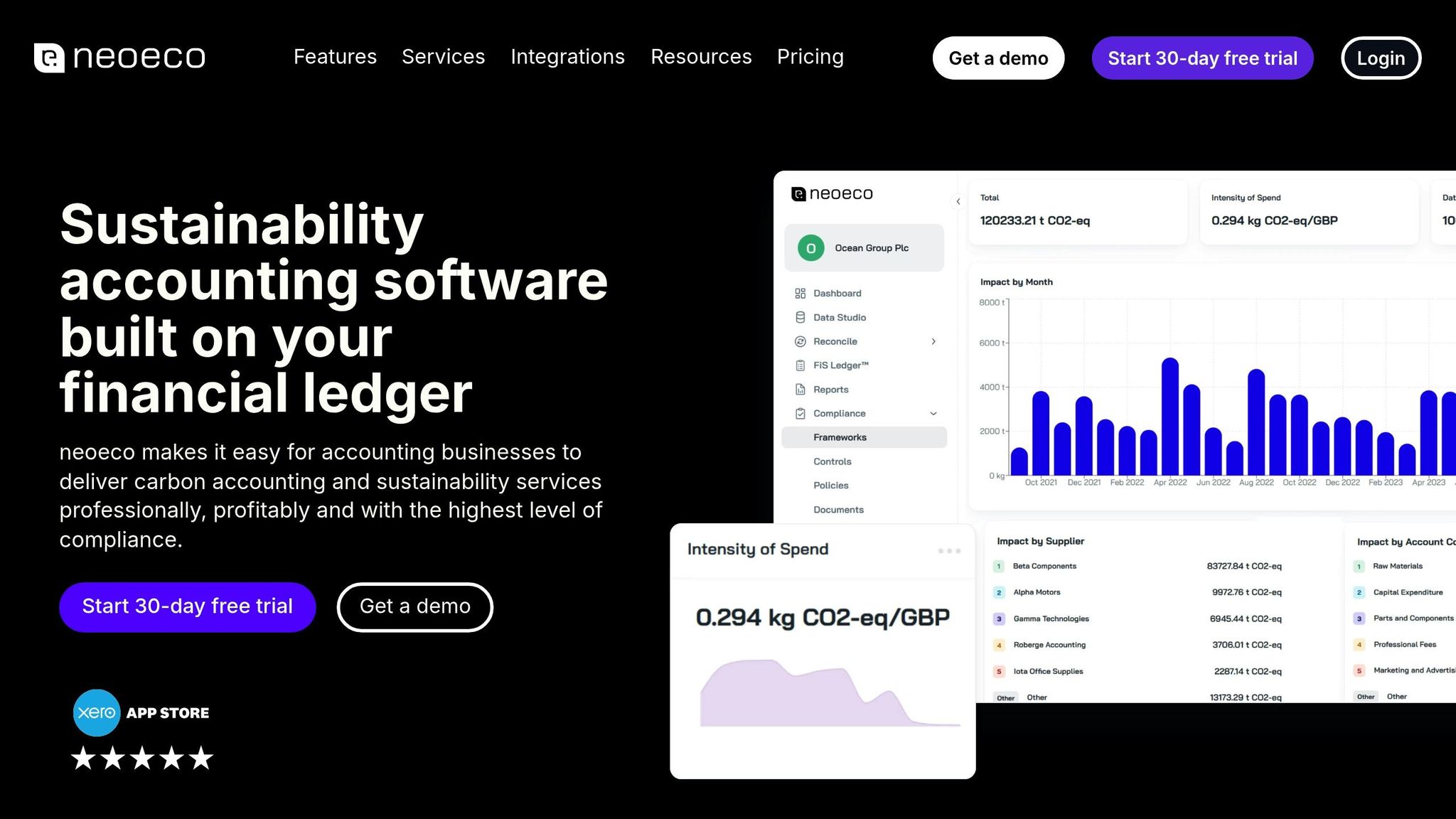
neoeco is designed specifically for UK and Australian accounting firms, integrating with platforms like Xero, Sage, and QuickBooks to simplify and enhance carbon accounting.
Centralised Data Management: Keep all your clients’ carbon and sustainability data in one place, avoiding the chaos of multiple spreadsheets and disjointed systems.
Smart Transaction Mapping: Automatically categorises transactions into Scope 1, 2, or 3 based on recognised standards.
Compliance-Ready Reports: Quickly produce templates for SECR, UK SRS, and ASRS 2, updated automatically to reflect regulatory changes.
Audit-Ready Features: Live checklists and secure document storage streamline audit processes, tracking every adjustment and linking data to supporting evidence.
Centralised Evidence Hub: Store invoices, supplier statements, and policy documents in one secure location, making audit preparation straightforward.
Auditor Access: Invite auditors to review evidence securely, cutting down on back-and-forth emails and ensuring full traceability.
Branded Reports for Clients: Generate professional reports featuring your firm’s branding, complete with charts, commentary, and clear disclosures.
Whether your clients are small businesses, large private companies, or voluntary reporters, neoeco provides a single platform to manage sustainability reporting from start to finish. Built around Financially-integrated Sustainability Management (FiSM), it bridges the gap between finance and sustainability, helping your firm stay ahead in a rapidly evolving field.
Manual vs Automated: Side-by-Side Comparison
Deciding between manual and automated error detection depends on your firm's size, the complexity of your clients, and your long-term goals. Both methods have their advantages, but knowing where each performs best can help you make an informed choice. Below, we break down the key differences to clarify how automation can address the limitations of manual processes.
Comparison Table
This table highlights the strengths of automated solutions compared to the challenges of manual methods.
Factor | Manual Methods | Automated Methods |
|---|---|---|
Accuracy | Susceptible to human errors, inconsistencies in spreadsheets, and struggles to maintain strict verification standards. | Delivers LCA-level precision, smart transaction matching, and audit-ready controls to ensure data accuracy and reliability. |
Efficiency | Time-intensive due to manual data entry, slow processing, and complex reconciliation tasks. | Connects directly with ledgers like Xero, Sage, and QuickBooks, automating data organisation, cleaning, and reporting with live dashboards for real-time insights. |
Scalability | Becomes unwieldy as client numbers, data, or compliance demands grow, resulting in fragmented management. | Handles multiple clients, projects, and data sets seamlessly, supporting high-volume reporting and multi-entity management within a single system. |
Compliance | Requires constant manual updates to keep up with changing regulations, making consistency difficult. | Automatically integrates regulatory updates and standardises processes to align with best practices. |
Audit Readiness | Relies on manual prep, scattered documentation, and lengthy communication with auditors. | Features centralised evidence hubs and audit-ready controls for streamlined, accessible audits. |
Cost | High labour costs due to staff hours, error corrections, and ongoing training. | Subscription-based pricing (often with a 30-day trial) reduces labour expenses and offers a strong return on investment by automating repetitive tasks. |
Speed | Processes can take weeks or months, depending on complexity and data volume. | Some users report completing emissions calculations in just two days. |
When to Use Manual Methods
There are cases where manual methods can work well, especially when automation isn't justified by the scale of operations. For example:
First-time reporters with simple needs: Spreadsheets may suffice for straightforward tasks, allowing time to learn the process before investing in automation.
One-off projects: If a client needs a single carbon footprint calculation for a grant or tender, manual methods can be enough if no ongoing reporting is required.
Small practices testing sustainability services: Starting manually can help assess client demand before committing to automated tools.
Clients with unique operations: For businesses that don't fit standard emissions categories, spreadsheets offer flexibility.
However, these situations often evolve. What starts as a one-time project can quickly become recurring work, making manual methods harder to sustain over time.
When Automation Is the Better Choice
For firms looking to scale operations or meet strict compliance standards, automation becomes essential. Consider automation if:
You manage clients across multiple locations: Automated platforms consolidate data from various subsidiaries or countries into a single dashboard.
High data volumes are involved: Automation reduces time spent on data handling, freeing your team to focus on advisory services.
Regulatory compliance is critical: Platforms simplify adherence to SECR, UK SRS, GHGP, and ISO 14064 by updating methodologies and ensuring consistency.
Audit preparation is a priority: Centralised evidence hubs and audit-ready features save significant time and effort.
You're scaling sustainability services: Automation supports professional, branded reports and real-time dashboards, helping you handle more clients without proportional cost increases.
For firms aiming to integrate sustainability reporting with financial processes, exploring Financially-integrated Sustainability Management (FiSM) can illustrate how automation directly linked to financial ledgers delivers better outcomes.
This comparison provides a clear framework to help firms align their error detection strategies with client needs and regulatory standards.
Conclusion: Selecting the Right Method for Your Firm
Choosing the best error detection method for your firm hinges on factors like scalability, compliance needs, and efficient use of resources.
For smaller, one-off projects, manual processes might do the job. But as client portfolios grow and regulatory requirements mount, these methods quickly become inefficient. It’s here that automation starts to shine. Automated platforms streamline operations by centralising client data, projects, and metrics into a single dashboard, allowing you to generate professional, consistent reports with ease.
With frameworks like GHGP, SECR, and UK SRS frequently evolving, staying on top of regulatory changes can be a challenge. Automated systems handle these updates seamlessly, simplifying compliance and audit preparations.
Resource limitations are another reason automation makes sense. When internal capacity is stretched, automation integrates smoothly with tools like Xero, Sage, and QuickBooks. This eliminates steep learning curves and lets you expand your sustainability services without disrupting existing workflows.
For firms looking to scale, neoeco offers a straightforward solution. By working directly with clients' financial ledgers, neoeco automatically maps transactions to emissions categories under frameworks like GHGP, ISO 14064, SECR, and UK SRS. Say goodbye to spreadsheets and manual conversions, and enjoy precise, finance-grade carbon data alongside audit-ready reports. Plus, neoeco offers a 30-day free trial and flexible monthly pricing, making it an easy step forward.
FAQs
What are the advantages of automated ESG error detection compared to manual methods for large firms?
Automating ESG error detection brings clear benefits, especially for larger organisations dealing with intricate data sets. By minimising human error, these systems deliver more precise and dependable outcomes, particularly when tracking emissions or evaluating sustainability metrics. This accuracy is crucial for adhering to standards like GHGP, ISO 14064, and SECR.
Moving away from spreadsheets and manual calculations, automated tools significantly cut down on time and effort while boosting overall efficiency. For instance, platforms like neoeco seamlessly connect with financial data to produce audit-ready reports and finance-grade carbon data, eliminating the need for tedious manual conversions. This not only simplifies operations but also provides confidence in compliance and ensures professional-quality reporting.
How do automated tools help accounting firms stay compliant with evolving ESG regulations?
Automated tools like neoeco make compliance straightforward by linking financial transactions directly to recognised emissions categories within established frameworks such as the GHGP, ISO 14064, SECR, UK SRS, and ASRS 2. This approach helps businesses generate precise, audit-ready reports without the hassle of spreadsheets or manual calculations.
By staying current with regulatory updates, these systems deliver finance-grade carbon data that adheres to the latest standards. This gives organisations the assurance they need to meet compliance obligations effectively and with professionalism.
When might manual ESG error detection be a better option than automated methods?
When it comes to ESG error detection, manual methods can often be a better fit for situations involving highly specialised data, limited datasets, or cases that demand expert interpretation. This approach is especially useful for smaller-scale or unique scenarios where automated tools might not capture the subtle, context-specific details effectively.
Manual processes also come into play when the expense or complexity of implementing automated systems outweighs their advantages. For example, firms that deal with infrequent or one-off ESG reporting tasks may find manual detection more practical. While automation is great for speed and handling large volumes, manual methods shine in their ability to adapt and apply human judgement to more intricate or nuanced cases.