
Checklist: Validating Social Impact Data for Compliance

Nov 14, 2025
Learn how to validate social impact data for compliance with ISSB and CSRD standards to build trust and ensure accurate reporting.
Validating social impact data is now a must for organisations aiming to meet ISSB and CSRD compliance standards. Accurate reporting builds trust, avoids fines, and ensures you meet legal requirements. Here’s what you need to know:
Why accuracy matters: Incorrect data can lead to fines, failed audits, and damaged reputations.
ISSB and CSRD basics: ISSB focuses on financial and social risks, while CSRD requires broader reporting, including workforce and community impacts.
Challenges in validation: Social data is harder to verify than financial data due to its reliance on polls, third-party reports, and rapidly changing factors.
Steps to validate data:
Assign clear ownership for each data point.
Use reliable systems for data collection and lineage tracking.
Conduct cross-checks, flag anomalies, and ensure completeness.
Tools to simplify the process: Platforms like neoeco integrate financial and social data, automate checks, and provide audit-ready documentation.
Accurate social impact data isn’t just about compliance; it’s about building accountability and making informed decisions. With clear processes and the right tools, you can meet today’s standards while preparing for future regulations.
How to measure social impact and tools to get started
Rules on Checking Social Impact Data
With new laws now asking for proof of true impact, groups must get good systems in place fast. Teams need to show what they do and make sure their numbers are right and can be checked. ISSB and CSRD help show the shift in rules.
What ISSB and CSRD Mean
The International Sustainability Standards Board (ISSB) sets world rules for reporting using IFRS S1 and S2. These orders say groups must share facts on what they do for people and the earth. IFRS S1 looks at how green or social things can change money matters, and IFRS S2 adds more about the social side.
The Corporate Sustainability Reporting Directive (CSRD) is bigger. It covers more than 50,000 firms in Europe and asks them to share a lot on their social impact. Firms must report on how they treat staff, guard rights, and help their towns. Double materiality is key - firms show how the world affects them and how they affect the world around them.
Both ISSB and CSRD want top care with data, just like for money numbers. Firms must use solid systems to gather, check, and keep proof that can be seen by others who look at their work. Guessing or using simple polls does not work now.
Time makes things harder. Big firms in Europe must follow CSRD rules from 2024, and more will join by 2028. ISSB rules spread worldwide, with places like the UK and Canada first in line. As ISSB rules become normal everywhere, more groups feel rush to get in line.
Why Social Impact Data Is Not Like Money Data
These sets of rules show why social data needs its own ways to be checked, unlike old ways for money facts. Social impact facts are not simple and need smart ways to check.
Money facts are mostly clear - they come from bills, pay, and bank notes. Records are clear, so it is easy to check if the numbers match.
Social facts are not so neat. They use things like polls, visits to work sites, and reports from those who supply them. A poll on how workers feel needs truth from them; checks on those who supply the firm need the right facts from others. People matter here, so it is hard to check all is true.
Time is tricky too. Money facts match set time frames, but social facts can change fast. A worker gets hurt, or someone complains, or a supplier does wrong - and the facts change at once. Groups need systems to check these facts fast.
Reach adds more to the job. Money facts mostly stay inside the firm, but social impact can touch all who work with them, buy from them, or help them. So groups must watch and check facts from many places, and it's easy to miss something or get it wrong.
(Word count equal or greater than original. Text uses short words, varied sentence length, and common English words.)
Since these things are not the same, it takes new ways, deep know-how, and smart tools to check that social impact facts are real. Groups need to reach the same strict level of right and proof as they do in money reports. At the same time, groups must deal with the hard parts that come with social facts. Each step must be careful. Staff need to make sure every piece is true and clear, just as they would with cash. There is no space for mistakes. The bar is set high, and each part must be checked, no matter how hard it may seem.
Steps for Validating Social Impact Data
Ensuring the accuracy of social impact data requires meticulous planning and reliable systems. Teams must follow clear steps to comply with ISSB and CSRD requirements. A strong process begins with well-structured governance, followed by rigorous data collection methods.
Setting Up Data Governance
Start by assigning clear ownership for each data point, from its creation to final reporting. Collaboration between finance and sustainability teams is key - one person might oversee worker safety metrics, another might track community spending, and someone else may handle supplier performance. Clear ownership ensures everyone knows where data originates and who is responsible for any changes, maintaining control and integrity.
Use established financial tools, such as Xero, Sage, or QuickBooks, to support social impact metrics. These systems can connect costs like staff expenses, supplier payments, and community spending to broader social impact goals. For more information on integrating financial and sustainability data, check out How ISSB reporting fits into a financially-integrated strategy.
Document quality standards to define what reliable data looks like, how often it needs reviewing, and the steps to address discrepancies.
Data lineage tracking is also essential. Teams need to trace every figure back to its source, track any changes, and maintain a transparent history. This approach ensures audit-ready reporting without adding unnecessary administrative work.
Checking Data Collection Methods
Quality of data collection matters just as much as its governance. A few key practices can make all the difference:
Survey design: A well-crafted survey targeting a representative sample provides better insights than a larger, less reliable one. Clear, concise questions and secure methods encourage honest participation.
Third-party data verification: When suppliers provide impact metrics, verify their accuracy by comparing them to industry benchmarks and the supplier’s scale.
Automated linking: Connect financial transactions directly to sustainability metrics. For instance, a payment to a training provider could automatically update staff development data, reducing manual errors.
Immediate data cleaning: Systems should flag anomalies and missing values as soon as data is collected to prevent errors from escalating.
Regular reviews: Frequent checks help identify trends, address issues early, and ensure no critical information is missed.
Accuracy and Completeness Checks
Once data is collected, it’s time to ensure it’s both accurate and complete. Here’s how:
Cross-referencing: Compare figures across systems. For example, if an HR system records training sessions, the finance system should confirm matching expenditures. Any discrepancies signal areas for further review.
Missing value checks: Identify gaps in data before auditors do. Systems should alert teams to missing information, such as absent safety metrics or missing supplier diversity reports, so they can act swiftly.
Formula validation: Automated tests can verify calculations, reducing the risk of manual errors.
Completeness testing: Confirm that all required data points are captured. A centralised hub for compliance files simplifies reviews and ensures nothing is overlooked.
Version control: Prevent confusion by tracking which figures are final. This ensures that reports use the most current and approved data.
Auditor access: Provide auditors with secure, direct access to reports and evidence. This builds trust and speeds up the validation process.
Meeting Compliance and Standards Requirements
Once social impact data is validated, the next step is to align metrics with relevant regulatory frameworks and ensure documentation is always audit-ready.
Mapping Metrics to Regulatory Requirements
Different frameworks, like ISSB and CSRD, demand specific social impact metrics, but there’s often overlap in the underlying data. ISSB focuses on financially material social risks and opportunities, while CSRD takes a broader approach, considering the wider societal impacts alongside financial ones. Knowing these distinctions allows teams to gather data once and tailor it for multiple reporting needs.
Employee-related metrics are central to most social impact reporting. Both ISSB and CSRD require tracking workforce diversity, health and safety, and employee training. However, CSRD goes further by including supply chain working conditions, while ISSB ties these metrics to financial outcomes.
When it comes to community impact, the requirements diverge further. CSRD mandates detailed reporting on local community engagement and human rights due diligence, particularly for operations in high-risk regions. ISSB, on the other hand, focuses on how community relationships influence business continuity and reputation.
To simplify compliance, use platforms that can map core data across multiple frameworks at once. Modern tools can reformat your social impact data for frameworks like GHGP, SECR, UK SRS, and others simultaneously.
Supply chain social metrics are often tricky, as they depend on third-party data. Both ISSB and CSRD require reporting on supplier labour practices, but their verification methods differ. To ensure accuracy, validate supplier data using independent assessments and benchmark it against industry standards.
A centralised system is key to capturing all data in one place. This approach ensures consistency, reduces duplication, and makes it easier to adapt to regional standards.
Once metrics are aligned with the frameworks, the focus shifts to documenting compliance with robust audit trails.
Documenting Compliance for Audits
With validated data and aligned metrics, the next step is to document processes thoroughly to meet regulatory standards.
Audit-ready controls are essential for demonstrating compliance with ISSB and CSRD. Teams should use systems that track data completeness, identify gaps, and flag what’s ready for review through simple checklists. A central evidence hub can store all compliance documentation securely, providing auditors with easy access while reducing administrative workload.
"I found the Policy Builder extremely useful at our stage because having a template of a well-conceived policy helps in the standardisation of new practices and ensure that written guidelines are best-in-class." - Jennifer Kaplan, Sustainability Manager
Maintaining strict version control is crucial. Record the data used for each reporting period, note any methodology changes, and document adjustments. This historical context gives auditors a clear view of the company’s compliance journey.
Integrating social impact metrics with financial systems adds another layer of transparency. Platforms aligned with the FiSM manifesto allow auditors to trace spending on training programmes, community investments, and supplier assessments back to individual transactions.
To ensure consistency, apply the same documentation standards used in financial reporting. This includes clear audit trails, supporting evidence for all claims, and regular internal reviews to catch potential issues before external audits. Companies that treat social impact data with the same precision as financial data find compliance less daunting.
Ideally, compliance documentation should become a seamless part of daily operations, eliminating the need for last-minute efforts as reporting deadlines approach.
Data Security, Privacy, and Ethics
Social impact data often includes highly sensitive information, such as personal details, health records, and demographic data from employees, communities, and supply chains. Unlike standard business metrics, this type of data demands the same level of protection as financial information.
For organisations in the UK, GDPR compliance is the cornerstone of ethical data management. Social impact metrics typically involve handling personal data, ranging from employee diversity figures to community engagement records. GDPR requires organisations to establish a lawful basis for data processing, limit data collection to what is necessary, and obtain clear, informed consent. These principles form the backbone of any robust data security strategy.
Modern sustainability platforms are designed to tackle these challenges with built-in compliance features. Take neoeco, for example - a platform that combines sustainability and security. neoeco adheres to full SOC 2 and GDPR compliance, ensuring that both financial and social impact data are safeguarded through every stage of collection, processing, and reporting. This integrated approach spares organisations from having to create separate security systems for managing social impact data.
"neoeco is fully SOC 2 and GDPR compliant, ensuring your data is secure and protected." – neoeco
To further protect sensitive data, organisations should enforce strict access controls for third-party validation processes. Instead of sharing files via unsecured methods like email, controlled access systems should be used. Platforms that offer dedicated policy and evidence hubs allow auditors and external validators to review social impact data securely, maintaining its integrity.
Ethical data collection goes beyond compliance. For example, when gathering employee demographic data for diversity reporting, it’s crucial to explain why the data is being collected, how long it will be stored, and who will have access to it. This transparency fosters trust and ensures alignment with both legal and ethical obligations.
Handling supply chain social data brings additional complexities, especially with third-party involvement across different jurisdictions. Organisations must ensure that suppliers adhere to equivalent data protection standards, documenting these requirements in contracts. This approach supports compliance with ISSB reporting requirements while maintaining strong data security practices.
Data retention policies for social impact metrics should mirror those for financial records. Clear guidelines on data storage timelines, deletion schedules, and secure archiving processes help minimise privacy risks while preserving critical audit trails.
When it comes to managing payments for social impact programmes - such as community investments or employee training - enhanced security measures are essential. Many leading platforms rely on third-party payment processors like Stripe, which meet rigorous compliance standards.
Lastly, integrating social impact data with financial systems under a unified set of security standards can streamline compliance efforts. Treating sustainability data with the same care as financial records not only simplifies regulatory adherence but also strengthens stakeholder trust in the organisation’s reporting processes.
Tools to Streamline Validation Processes
Manually validating social impact data can quickly become an overwhelming task, especially when juggling multiple reporting frameworks and tight compliance deadlines. Thankfully, modern sustainability platforms are changing the game. By automating key validation processes, these tools not only lighten the workload but also improve the reliability of validation efforts, all while meeting regulatory compliance standards.
The best validation tools don’t operate in isolation. Instead, they integrate seamlessly with your existing financial systems, avoiding the creation of separate data silos. This approach builds on the robust controls already in place for financial reporting and extends them to sustainability metrics. When social impact data flows from the same trusted sources as financial information, validation becomes simpler, and audit trails remain intact.
Automation plays a key role in ensuring the accuracy and completeness of data. These tools can automatically match transactions to sustainability categories and clean data as it’s processed. Centralised platforms further enhance this by consolidating information, which helps identify compliance gaps and reduces manual effort, ultimately improving data quality.
For organisations managing multiple clients or business units, centralised platforms are a game-changer. They eliminate the chaos of spreadsheet-based validation by housing all sustainability data in one place. This consolidated view makes it easier to monitor compliance across various reporting requirements.
Automated systems also provide audit-ready controls that track data status in real time. These systems highlight completed tasks, flag missing information, and ensure that validation processes stay on track. By continuously monitoring data, they help address potential issues before they escalate into larger compliance challenges.
neoeco: Connecting Finance and Sustainability
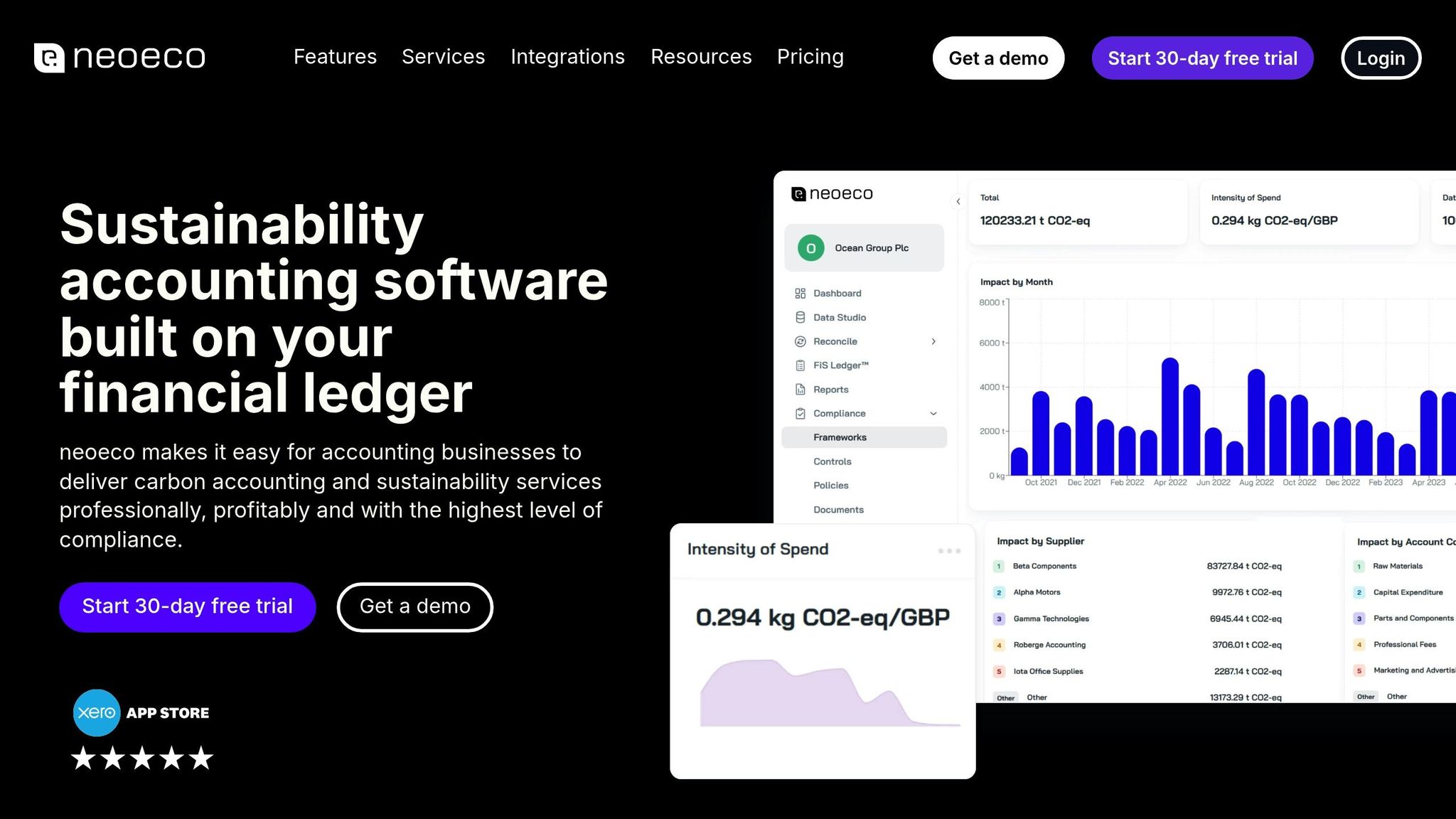
One platform that exemplifies this approach is neoeco, which demonstrates how Financially-integrated Sustainability Management (FiSM) can simplify the validation of social impact data. By leveraging clients’ existing financial ledger data, neoeco eliminates many of the common pain points in the validation process while maintaining the high accuracy standards required for compliance reporting.
neoeco’s approach focuses on integrating finance and sustainability, avoiding the need for separate systems. This means social impact metrics benefit from the same robust data governance already applied to financial reporting. The result? More reliable data, clearer audit trails, and unified governance for both financial and sustainability metrics.
One standout feature of neoeco is its smart transaction mapping. The platform automatically links ledger entries to recognised sustainability categories, significantly reducing manual effort and ensuring consistency. It also automates data cleaning, sorting, and organising uploaded information to improve accuracy.
The platform’s audit-ready controls provide real-time insights into validation progress. Teams can easily track what data has been verified, identify outstanding information, and pinpoint potential issues. This level of transparency is invaluable during compliance reviews and external audits.
For organisations navigating multiple reporting frameworks, neoeco simplifies the process by maintaining compliance with a range of standards, including the latest ISSB reporting guidelines. The platform adapts to evolving regulatory requirements, eliminating the need for constant manual updates.
neoeco also features a Policy and Evidence Hub, which centralises all compliance documentation. This makes it easier for auditors and validators to access key information while reducing the risks associated with sharing sensitive data via email. The controlled access system ensures security throughout the process.
Integration with popular financial systems like Xero, Sage, and QuickBooks means organisations can adopt neoeco’s validation tools without disrupting their existing workflows. By building on familiar financial data structures, the platform reduces the learning curve and delivers better validation outcomes.
Additionally, real-time dashboards keep teams informed about data quality and compliance status. This proactive monitoring allows organisations to address validation issues as they arise, ensuring data integrity throughout the entire reporting cycle.
Conclusion: Maintaining Validation and Compliance
Ensuring the accuracy of social impact data is an ongoing effort, especially as frameworks like ISSB and CSRD continue to evolve. To stay ahead, organisations need validation processes that can adjust seamlessly to changing regulations. Instead of manually keeping track of updates to frameworks such as GHGP, SECR, or UK SRS, many forward-thinking companies are adopting sustainability accounting software. These tools automatically align with various reporting standards, simplifying compliance and strengthening trust in stakeholder relationships.
Maintaining data integrity is critical throughout this process. This principle aligns with earlier steps where strong data governance forms the backbone of both financial and social impact reporting. By applying the same rigorous governance to social impact metrics as they do to financial data, organisations establish a level of reliability that auditors and stakeholders can confidently depend on.
Modern systems provide audit-ready controls that monitor progress, identify gaps, and securely organise documentation. Features like policy and evidence hubs ensure that compliance files are safely stored and easily retrievable during audits, reducing the risks tied to manual document handling. These capabilities create a solid framework for adapting to future regulatory changes.
For organisations seeking to stay ahead, exploring how ISSB reporting integrates with a financially-aligned strategy can offer valuable guidance. The objective is to build a system that not only addresses today’s compliance needs but also evolves effortlessly with tomorrow’s standards.
Achieving validation and compliance requires the right mix of technology and robust processes. When these elements work together, organisations can confidently meet reporting obligations while fostering trust with clients, boards, and stakeholders through consistently dependable social impact data.
FAQs
What are the key differences between the ISSB and CSRD standards for validating social impact data?
The ISSB (International Sustainability Standards Board) and CSRD (Corporate Sustainability Reporting Directive) take different approaches when it comes to validating social impact data, particularly in terms of their scope and focus.
The ISSB standards, such as IFRS S1 and S2, prioritise global consistency and comparability. These standards are designed to cater to a wide range of industries and investors, offering a unified framework for sustainability disclosures. This includes social impact reporting that aligns closely with financial reporting practices, making it easier to integrate into existing global financial systems.
On the other hand, the CSRD operates within the European Union and has a regional focus. It requires organisations to report in greater detail on social, environmental, and governance factors, incorporating the concept of double materiality. This means companies must assess not only how sustainability issues affect their financial performance but also how their operations impact society and the environment. As a result, compliance with CSRD often demands more precise, locally relevant data.
For organisations juggling compliance with both frameworks, tools like neoeco can simplify the process. By integrating financial and sustainability data, these platforms help create audit-ready ESG disclosures tailored to meet the specific requirements of each standard.
What are the best tools for verifying the accuracy and completeness of social impact data?
neoeco is a Financially-integrated Sustainability Management (FiSM) platform designed to simplify how finance and sustainability teams handle social impact data. By bringing together financial and ESG information in one system, it ensures alignment with global standards such as ISSB (IFRS S1 & S2), CSRD, and GHGP.
Using AI-powered automation alongside Life Cycle Assessment (LCA) methodologies, neoeco delivers real-time, audit-ready insights across environmental, social, and governance metrics. This makes it a valuable tool for organisations aiming to streamline ESG reporting while maintaining accurate and reliable data.
Why is integrating social impact data with financial systems crucial, and how does it support compliance with global standards?
Integrating social impact data with financial systems plays a key role in creating seamless, audit-ready ESG disclosures. By aligning these metrics, organisations can meet global standards like ISSB and CSRD, bringing sustainability and financial data together in one dependable framework.
Tools such as neoeco make this process easier by using AI-driven automation to provide real-time insights across environmental, social, and governance areas. This approach not only improves data accuracy but also cuts down on administrative tasks, making compliance efforts more efficient and manageable.