Top 5 Tools for TCFD Climate Risk Reporting
Nov 15, 2025
Explore essential tools for TCFD climate risk reporting, enabling organisations to streamline compliance and integrate sustainability data effectively.
In the UK, TCFD (Task Force on Climate-related Financial Disclosures) reporting is now a key requirement for businesses. Since its 2021 mandate, organisations have faced challenges like data collection, scenario analysis, and aligning multiple frameworks. To simplify this process, specialised tools can help integrate financial and climate data, automate reporting, and ensure compliance.
Here are five tools designed for TCFD reporting:
ClimateAi: Focuses on climate risks in operations and supply chains, offering scenario analysis and TCFD alignment.
EcoAct's Climate Risk Tool (ECLR): Covers physical and transition risks, with strong support for TCFD and other frameworks.
EY Climate Analytics Platform (EY CAP): Provides enterprise-level risk assessments with advanced scenario modelling.
S&P Global Climanomics: Combines financial, economic, and climate data for detailed risk analysis, suited for large organisations.
neoeco: Links financial data with sustainability metrics, offering cost-effective solutions for SMEs and private companies.
Each tool caters to different needs, from large enterprises requiring complex modelling to smaller businesses seeking simpler integration. Whether it's managing risks, automating compliance, or connecting financial data with climate insights, these tools streamline TCFD reporting while addressing unique organisational requirements.
The Best Climate Risk Assessment Method for Small and Medium Sized Companies | AI Supported | TCFD
1. ClimateAi
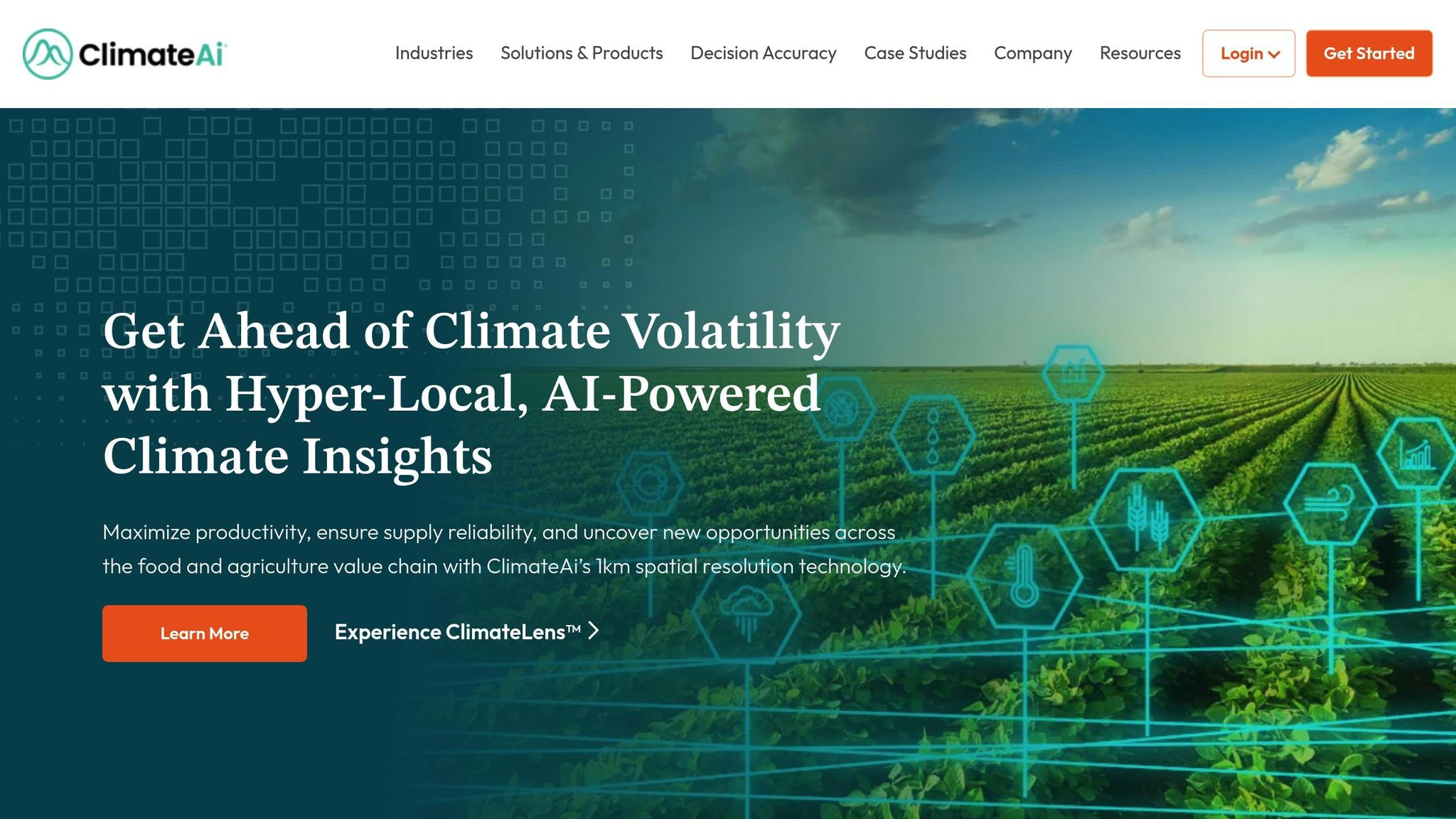
Let’s start by looking at ClimateAi and its role within the TCFD framework. ClimateAi is an AI-powered platform designed to evaluate climate risks affecting operations and supply chains. While the platform offers TCFD reporting features such as data integration and scenario analysis, the specifics of these capabilities aren’t fully detailed.
For organisations in the UK exploring ClimateAi as part of their climate risk management efforts, it’s a good idea to dig deeper. Understanding how the platform aligns with TCFD reporting and fits into your existing processes is crucial. To get a clearer picture, consider reaching out to ClimateAi directly for more tailored information.
2. EcoAct's Climate Risk Tool (ECLR)
EcoAct's Climate Risk Tool (ECLR) is designed to streamline climate risk assessments while aligning with global frameworks like TCFD. Built around TCFD’s four key pillars - governance, strategy, risk management, and metrics and targets - the tool uses scenario analysis to evaluate both physical risks (like extreme weather events) and transition risks (such as regulatory or market changes).
Beyond TCFD, ECLR also supports reporting for frameworks like CDP and various regulatory standards, making it a practical solution for organisations juggling multiple climate disclosure requirements. Its comprehensive design ensures it not only meets reporting needs but also complements other tools with similar objectives.
3. EY Climate Analytics Platform (EY CAP)
The EY Climate Analytics Platform (EY CAP) is designed to assist organisations in meeting TCFD compliance by combining powerful data integration with scenario analysis. By bringing together climate and operational data, the platform provides detailed risk assessments for individual assets and entire portfolios. Its scenario analysis tools - covering frameworks like the Network for Greening the Financial System (NGFS) along with tailored pathways - enable businesses to evaluate how different levels of global warming could impact their operations and financial outcomes over time.
4. S&P Global Climanomics Platform
The S&P Global Climanomics Platform brings together financial, economic, and environmental data to provide in-depth climate risk analysis. By integrating diverse datasets with advanced modelling tools, it enables organisations to assess how climate change could impact their operations and financial outcomes.
Data Integration and Scenario Analysis
This platform stands out for its ability to merge various data streams. It incorporates physical risk data - like extreme weather events, rising sea levels, and temperature shifts - alongside transition risk indicators, such as changes in policies and carbon pricing. Using proprietary databases, it delivers a comprehensive view of climate-related financial risks. Its scenario analysis feature allows users to explore multiple pathways based on established frameworks, including the Intergovernmental Panel on Climate Change (IPCC) and the Network for Greening the Financial System (NGFS). Businesses can simulate impacts under different warming scenarios and translate these into financial metrics like revenue effects, asset valuations, and credit risks.
Alignment with TCFD and Organisational Fit
The Climanomics Platform is tailored to support TCFD-aligned reporting, offering pre-built templates that cover governance, strategy, risk management, and metrics. This makes the reporting process more efficient. Its robust data coverage and advanced modelling make it particularly suited for large enterprises and financial institutions with complex portfolios. However, its focus on enterprise-level functionality and pricing may pose challenges for smaller or mid-sized organisations looking for simpler solutions. This positions the platform as an excellent choice for larger businesses, while leaving room for other tools to cater to a broader range of needs.
5. neoeco
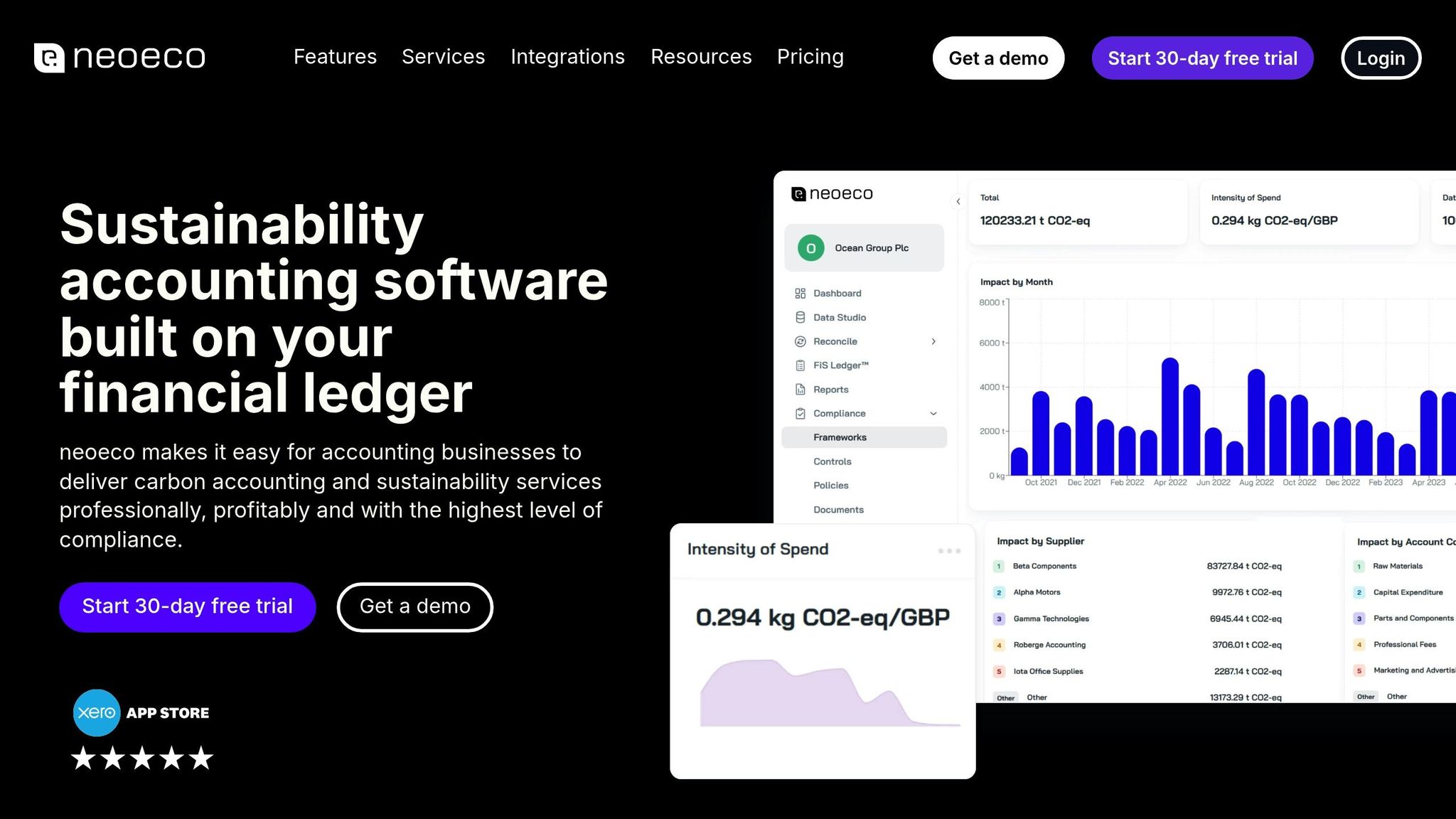
neoeco brings together sustainability data and financial insights by connecting directly with popular accounting platforms like Xero, Sage, and QuickBooks. This integration provides a clear, combined view of both financial and environmental performance, while its features simplify the reporting process.
Automation Capabilities
With its smart matching technology, neoeco automatically links financial transactions to relevant carbon data. It also makes data organisation hassle-free with drag-and-drop tools, enabling users to clean and sort information quickly. The platform’s report builder generates polished, chart-filled reports in just minutes, and live dashboards ensure real-time updates - so reporting isn’t restricted to quarterly or annual cycles.
For audits, neoeco offers built-in controls to track progress and flag missing details. Its Policy and evidence hub securely stores compliance files, giving auditors direct access to necessary documents without back-and-forth emails.
Data Integration and Scenario Analysis
neoeco works seamlessly with major financial systems like Microsoft Business Central and SAP, letting organisations use trusted data without duplicating work. Additionally, its connection with Xycle supports ISO-compliant Life Cycle Assessment modelling. By centralising financial and sustainability data, neoeco helps organisations understand the financial impact of climate-related risks and opportunities.
"neoeco helps us look like heroes to our clients. It connects financial and sustainability data in one place - saving us hours every month and helping our clients meet reporting requirements with confidence."
neoeco website
Alignment with TCFD and Other Frameworks
neoeco’s approach ties climate risks directly to financial performance, aligning with frameworks like the TCFD. Its audit-ready controls and secure evidence hub enhance governance and risk management, while instant trust sharing gives boards and stakeholders immediate access to verified and current climate data. The platform also demonstrates how ISSB reporting can integrate smoothly into existing processes.
Organisational Scale Suitability
Tailored for accounting firms and their clients, neoeco delivers professional-grade climate reporting without the complexities of enterprise-scale systems. With pricing starting at £399 per year for carbon-only reporting, and compliance with SOC 2 and GDPR standards, it’s a practical choice for SMEs and larger private companies that don’t have dedicated sustainability teams.
Tool Comparison Table
Selecting the right TCFD reporting tool hinges on your organisation's specific needs, technical capabilities, and budget. To simplify the decision-making process, the table below outlines and compares five tools across critical criteria.
Tool | Primary Use Case | Key Hazards & Metrics | Scenario Capabilities | Framework Alignment | Integration Options | Best Suited For |
|---|---|---|---|---|---|---|
ClimateAi | Physical risk assessment and agricultural impact modelling | Temperature, precipitation, extreme weather events, crop yield impacts | Advanced climate projections with multiple warming scenarios | TCFD physical risk disclosure | API connections, agricultural data feeds | Agricultural companies, food supply chains, asset managers |
EcoAct's ECLR | Comprehensive climate risk assessment across sectors | Physical and transition risks, carbon pricing, regulatory changes | Scenario analysis aligned with NGFS pathways | TCFD, EU Taxonomy, CSRD | ERP systems, sustainability platforms | Large corporates, financial institutions |
EY CAP | Enterprise-wide climate analytics and strategic planning | Physical risks, transition costs, stranded assets, regulatory exposure | Proprietary scenario modelling with financial impact quantification | TCFD, ISSB, CSRD | SAP, Oracle, custom enterprise systems | Multinational corporations, complex organisations |
S&P Global Climanomics | Financial risk quantification and portfolio analysis | Credit risk, asset valuation, sectoral exposure, sovereign risk | Multiple climate scenarios with economic impact models | TCFD, Basel III, regulatory capital requirements | Bloomberg, Refinitiv, banking systems | Banks, asset managers, insurance companies |
neoeco | Financially integrated sustainability reporting | Scope 1, 2 & 3 emissions, carbon intensity, financial performance correlation | Automated reporting powered by integrated financial data | GHGP, SECR, UK SRS, with ISSB reporting alignment | Xero, Sage, QuickBooks, Microsoft Business Central, SAP | SMEs, accounting firms, private companies |
This comparison highlights each tool's primary focus, scenario capabilities, framework alignment, and integration options to help you decide with confidence. The detailed reviews above complement this summary by offering deeper insights into the tools' features.
ClimateAi and EcoAct's ECLR are tailored for sectors that are particularly vulnerable to climate risks, focusing on physical risk assessments and regulatory changes. On the other hand, EY CAP and S&P Global Climanomics are designed for large enterprises requiring advanced scenario modelling and compliance with complex regulatory frameworks. Meanwhile, neoeco stands out for its seamless integration of financial and sustainability data, making it a practical and cost-effective choice for smaller organisations.
When it comes to pricing, the tools vary widely. Enterprise-level solutions like EY CAP and S&P Global Climanomics often come with higher costs, reflecting their comprehensive features and scalability. In contrast, neoeco offers an affordable entry point, with its carbon-only plan starting at £399 per year - ideal for smaller businesses beginning their TCFD reporting journey.
Ease of implementation is another factor to consider. While enterprise platforms may require months of setup and technical expertise, neoeco simplifies the process with direct integration into popular accounting systems, enabling quicker deployment.
The ability to integrate climate risk data with financial insights is becoming increasingly important, especially as organisations align with ISSB reporting. This trend underscores the growing emphasis on actionable, data-driven sustainability management.
Conclusion
Selecting the right TCFD tool depends on your organisation's specific needs, resources, and compliance requirements. The five tools reviewed here highlight that there’s no universal solution. Whether it’s ClimateAi's focus on agriculture or S&P Global Climanomics' emphasis on financial risk assessment, each tool brings a unique perspective to aligning climate risk data with financial insights.
A key factor to consider is how well a tool integrates with your existing systems. Solutions that utilise reliable financial data can eliminate the hassle of messy spreadsheets and reduce the manual effort that often complicates traditional reporting. This integration is vital for effective TCFD reporting, especially when organisations need to ensure compliance across multiple frameworks with audit-ready precision.
Implementation timelines vary widely, from a few days for simpler tools to several months for more complex enterprise systems. This distinction is particularly critical for companies with tight reporting deadlines or limited internal sustainability expertise.
The cost of failing to comply with TCFD standards can far exceed the investment in the right tools. Jennifer Kaplan, a Sustainability Manager, underscored the importance of structured approaches:
"I found the Policy Builder extremely useful at our stage because having a template of a well-conceived policy helps in the standardisation of new practices and ensure that written guidelines are best-in-class."
Looking to the future, the integration of financial and sustainability reporting under frameworks like ISSB reporting will require tools that can adapt to changing regulations. Organisations investing in platforms that consolidate emissions and environmental data into actionable insights can not only meet current TCFD standards but also develop strategic plans for long-term carbon reduction.
Ultimately, successful TCFD adoption hinges on the right combination of technology and organisational commitment. These tools do more than simplify reporting - they empower businesses to understand and mitigate their environmental impact, while building trust with stakeholders through accurate and timely climate risk disclosures.
FAQs
What should I consider when selecting a TCFD reporting tool for my organisation?
Choosing the right TCFD reporting tool boils down to understanding your organisation's specific needs, goals, and the systems you already have in place. Start by checking if the tool supports TCFD-aligned reporting and works smoothly with your existing finance and sustainability data. Features like automation, real-time insights, and compatibility with global standards such as ISSB, CSRD, and GHGP are essential.
You’ll also want a tool that offers detailed data analysis and can grow with your organisation's future demands. For instance, platforms like neoeco bring together finance and sustainability data, making audit-ready ESG disclosures simpler while using AI to boost efficiency. Make sure the tool matches your sector, organisation size, and the complexity of your reporting needs to make compliance and decision-making more straightforward.
What are the key differences between TCFD reporting tools for large enterprises and SMEs?
The key differences between TCFD reporting tools for large enterprises and SMEs often come down to scalability, complexity, and cost. Tools built for large enterprises are typically packed with advanced features like extensive data integration, AI-powered automation, and customisation capabilities designed to manage the intricate needs of multi-entity operations. These tools also tend to align with a broader array of global standards and frameworks.
On the other hand, SME-focused tools are designed to be simpler and easier to use. They emphasise affordability and include essential features tailored to smaller organisations, such as basic data collection and user-friendly reporting templates. Selecting the right tool hinges on an organisation’s size, budget, and specific reporting requirements.
How can these tools support compliance with multiple climate disclosure frameworks, including TCFD?
These tools aim to make it easier for organisations to comply with different climate disclosure frameworks by automating how data is collected, integrated, and reported. By bringing together sustainability and financial data, they enable alignment with frameworks like TCFD, ISSB, CSRD, and GHGP.
Platforms such as neoeco take things a step further by using AI-powered automation and techniques like Life Cycle Assessment (LCA) to provide detailed, audit-ready insights. This allows organisations to meet the demands of multiple frameworks efficiently while ensuring their reporting remains accurate and transparent.