ISO 14064-1 Explained: Scope 1, 2, and 3 Emissions
Dec 14, 2025
Practical ISO 14064-1 overview: classify Scope 1, 2 and 3 emissions, build a compliant GHG inventory and prepare for UK verification.
ISO 14064-1 is a global standard for measuring and reporting greenhouse gas (GHG) emissions. It ensures organisations can create accurate, verifiable emissions inventories by categorising emissions into three scopes:
Scope 1: Direct emissions from owned or controlled sources (e.g., fuel combustion, company vehicles).
Scope 2: Indirect emissions from purchased energy (e.g., electricity, heating).
Scope 3: Indirect emissions across the value chain (e.g., business travel, supply chain activities).
This standard complements the GHG Protocol by focusing on reporting and verification, making it highly relevant for UK organisations complying with frameworks like SECR and UK SRS. Tools like neoeco simplify this process by automating data collection, mapping emissions categories, and ensuring audit readiness.
ISO 14064-1 Scope 1, 2, and 3 Emissions Framework
ISO 14064-1:2018 Greenhouse Gas Quantification and Reporting
Scope 1, 2, and 3 Emissions Under ISO 14064-1
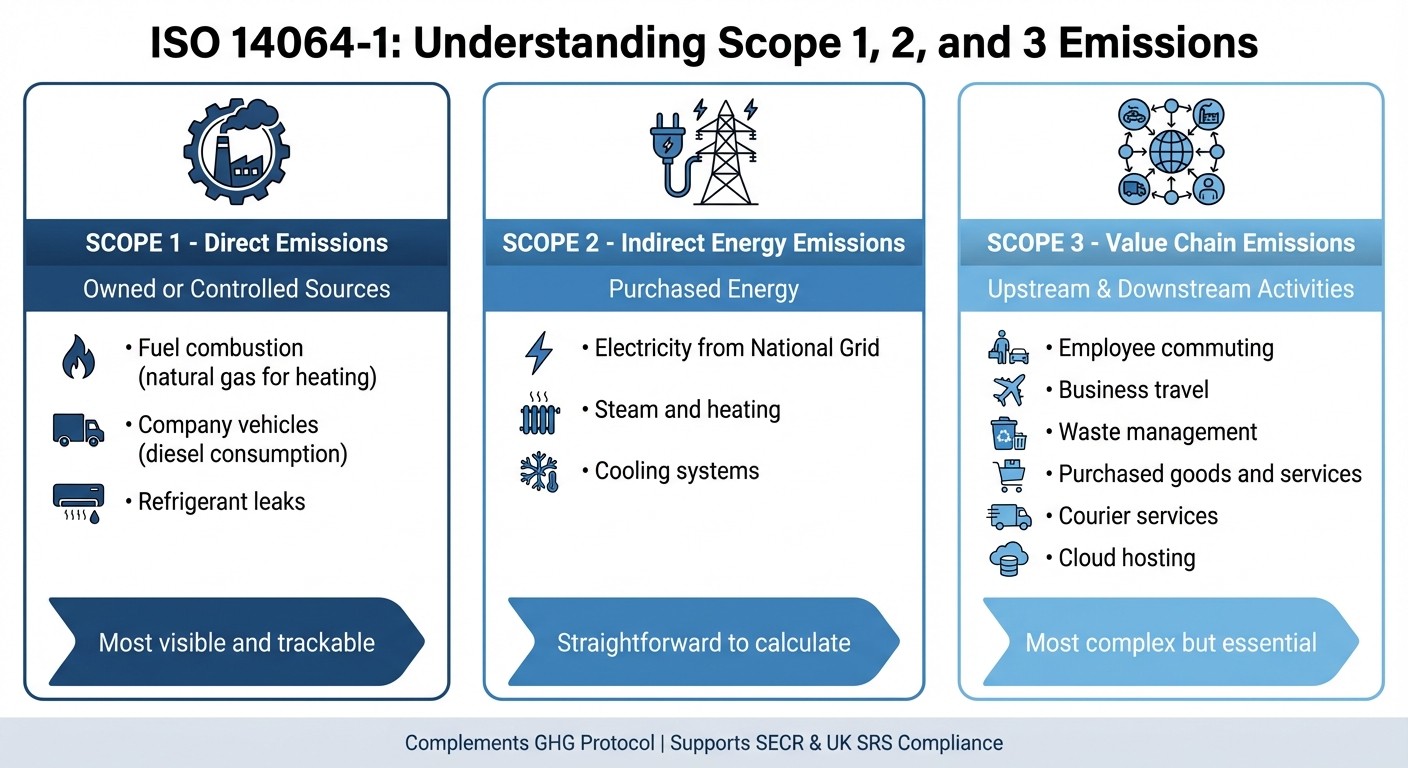
ISO 14064-1 provides a framework for quantifying greenhouse gas (GHG) emissions, categorising them into three key scopes: Scope 1 (direct emissions), Scope 2 (indirect energy emissions), and Scope 3 (value chain emissions). These categories are crucial for compliance with SECR and UK SRS standards. Let’s break down each scope.
Scope 1: Direct Emissions
Scope 1 refers to emissions from sources that are directly owned or controlled by an organisation. These include emissions from natural gas used for heating, diesel consumed by company vehicles, and leaks from refrigerants. Since these emissions stem from day-to-day operations, they are often the most visible and can typically be tracked using utility bills or fuel receipts. With Scope 1 covered, let’s move to emissions from purchased energy.
Scope 2: Indirect Energy Emissions
Scope 2 accounts for emissions linked to energy purchased and consumed by an organisation, such as electricity, steam, heat, or cooling. In the UK, this often pertains to electricity sourced from the National Grid, where carbon intensity depends on the current energy mix. Since energy usage is frequently monitored for budgeting, calculating Scope 2 emissions is generally straightforward. Now, let’s explore the broader category of value chain emissions under Scope 3.
Scope 3: Value Chain Emissions
Scope 3 encompasses all other indirect emissions across an organisation’s value chain, both upstream and downstream. This broad category includes emissions from employee commuting, business travel, waste management, and the production and transportation of purchased goods and services. For organisations in the UK, this might also extend to emissions from courier services or cloud hosting providers. While measuring Scope 3 emissions can be complex, they are essential for a full picture of an organisation’s carbon footprint. For tailored tools to manage Scope 3 emissions, visit neoeco.
How ISO 14064-1 Categories Map to Scope 1, 2, and 3
ISO 14064-1 provides a structure for reporting greenhouse gas (GHG) emissions, aligning well with the GHG Protocol's definitions for Scope 1, Scope 2, and Scope 3 emissions. In the UK, this framework helps organisations align their GHG inventories with SECR and UK SRS requirements, offering a practical foundation for reporting.
Mapping Emission Categories to GHG Protocol Scopes

ISO 14064-1 categorises emissions broadly, without a strict numerical mapping to the GHG Protocol scopes. In general:
Scope 1: Covers direct emissions, such as on-site fuel combustion or emissions from company-owned vehicles.
Scope 2: Includes indirect emissions from purchased energy, like electricity from the National Grid.
Scope 3: Encompasses all other indirect emissions, such as those from business travel, supply chain activities, and waste management.
Each organisation needs to review its specific operations and supply chain to classify emissions accurately within these categories.
UK Examples in Practice
Different sectors in the UK interpret these classifications based on their unique operations:
A professional services firm in London might classify on-site energy use as direct emissions (Scope 1) while categorising business travel as part of its value chain emissions (Scope 3).
A manufacturing company might report emissions from on-site fuel combustion under Scope 1, account for electricity used in production under Scope 2, and include supplier activities or waste disposal under Scope 3.
GHG Removals and Carbon Credits
ISO 14064-1 also emphasises the importance of reporting GHG removals separately from emissions. This ensures transparency by clearly distinguishing gross emissions from any offsets or carbon credits an organisation has acquired. Such separation is crucial for organisations aiming for net-zero targets, as it helps differentiate between actual emissions produced and credited removals used to offset them.
For a more integrated approach to managing emissions data, consider exploring neoeco's FiSM framework.
Building an ISO 14064-1 Compliant GHG Inventory
Steps to Create Your GHG Inventory
To build a compliant greenhouse gas (GHG) inventory, start by defining your reporting boundaries. These could be based on operational control, financial control, or equity share, and they should cover Scope 1, 2, and 3 emissions. Once the boundaries are set, identify all relevant emission sources using financial data from platforms like Xero, Sage, or QuickBooks.
Next, select appropriate calculation methods and use the latest UK Government GHG conversion factors to ensure accuracy. Transparency is critical - document every assumption and method to create a clear audit trail. For businesses managing multiple clients, it’s important to establish a process that’s both repeatable and scalable, minimising unnecessary admin work.
After defining your boundaries and methods, consolidate your data sources to create a robust, verifiable inventory.
Data Sources and Evidence Requirements
Your primary data sources will include records like utility bills, fuel invoices, travel expense claims, and procurement documents - essentially, any financial transaction tied to emissions. Here’s how it breaks down by scope:
Scope 1: Records of fuel purchases and on-site combustion events.
Scope 2: Electricity and heating invoices showing consumption in kilowatt-hours.
Scope 3: Supplier invoices, freight documentation, and employee expense reports.
All supporting documentation should be stored in a centralised location for easy auditor access. This includes invoices, worksheets showing calculations, sources for conversion factors, and records of decisions on boundary setting. Auditors will need to trace your reported emissions back to the raw data, so having a well-organised evidence hub is essential for ISO 14064 verification.
While manual data collection and validation can be time-consuming, leveraging technology can make this process far more efficient.
How neoeco Simplifies GHG Inventories
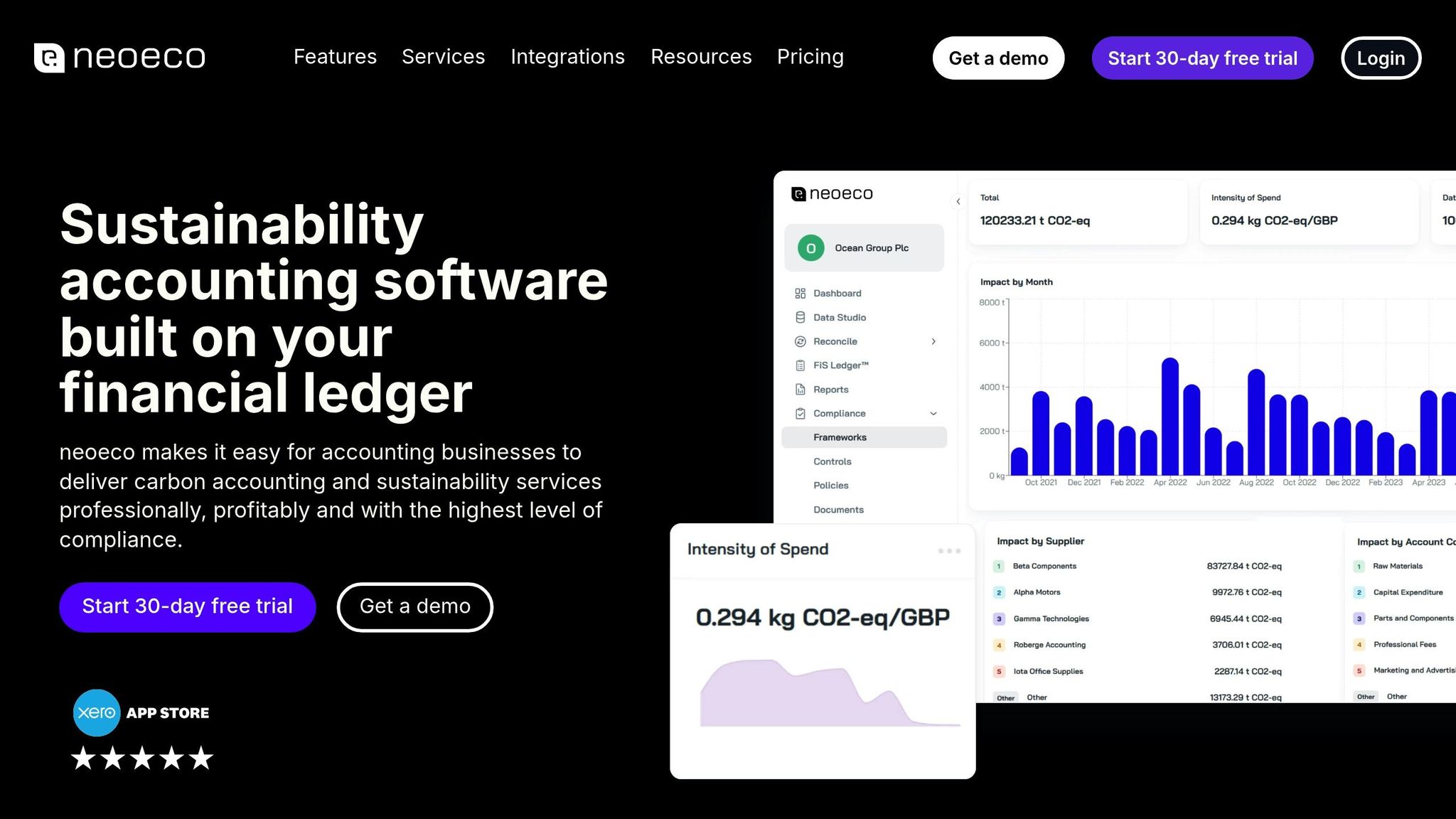
neoeco takes much of the hassle out of creating a GHG inventory. It connects directly to your existing financial systems and uses smart matching technology to automatically map transactions to the correct ISO 14064-1 emission categories. The platform identifies which activities generate emissions and applies the right conversion factors from trusted databases.
"We evaluated multiple ESG tools and felt more confused each time. neoeco cut through the noise - the only platform that connects financials to sustainability with LCA-level accuracy."
With audit-ready controls, neoeco securely stores all compliance files and gives auditors direct access to reports. This seamless integration aligns carbon accounting with financial accounting under the principles of Financially-integrated Sustainability Management, making the process both accurate and efficient.
Verification, Assurance, and Technology
Verification and Validation Under ISO 14064
To ensure credibility, ISO 14064-1 inventories require independent third-party verification. This process involves a thorough review of greenhouse gas (GHG) data, calculations, and supporting documentation to confirm compliance with the standard's requirements. Auditors check that organisational boundaries are accurately defined, all emission sources are accounted for, and calculation methods are applied correctly.
A complete audit trail - from invoices to reported emissions - is crucial. Auditors scrutinise the chosen emission factors, evaluate how uncertainties or estimates are handled, and ensure consistency across reporting periods. Before undergoing external assurance, robust internal verification processes help guarantee the quality and completeness of the data.
Why Spreadsheets Fall Short for GHG Reporting
Although a solid audit trail is vital, traditional tools like spreadsheets often compromise data accuracy. Spreadsheets are prone to errors, such as broken formulas, overwritten data, and poor version control. A single misplaced decimal point or incorrect cell reference can skew an entire GHG inventory. Moreover, spreadsheets lack the necessary audit-ready controls - there’s no built-in way to track who made changes, when they occurred, or why. As a result, firms frequently waste time piecing together the data narrative during verification, which can undermine the credibility of their reporting.
How neoeco Supports ISO 14064-1 Compliance
To address these challenges, technology solutions like neoeco provide a more reliable approach. neoeco integrates with financial systems such as Xero, Sage, and QuickBooks, automatically mapping transactions to ISO 14064-1 categories for greater speed and accuracy. The platform includes audit-ready controls, featuring a simple checklist to track progress and flag any missing evidence. A centralised policy and evidence hub securely stores all compliance documents, allowing auditors direct access to the necessary files - eliminating the back-and-forth of endless email exchanges.
"neoeco makes it easy for accounting businesses to deliver carbon accounting and sustainability services professionally, profitably and with the highest level of compliance." – neoeco
On top of that, neoeco is fully SOC 2 and GDPR compliant, ensuring sensitive client data remains secure throughout the verification process. For firms juggling multiple clients across various reporting frameworks - such as GHGP, SECR, or UK SRS - neoeco consolidates all data into one system, making ISO 14064-1 compliant reporting more straightforward and efficient.
Conclusion
Why ISO 14064-1 Matters for UK Sustainability Reporting
ISO 14064-1 provides UK accounting firms with a clear framework to create accurate and transparent greenhouse gas (GHG) inventories that meet the requirements of SECR and UK SRS. Without this structured approach, firms could face inconsistent calculations, incomplete data, and potential audit failures - issues that can erode client confidence.
But it’s not just about compliance. ISO 14064-1 also opens doors for growth. As sustainability reporting becomes a standard requirement, firms offering expert carbon accounting services will be well-positioned to meet increasing client demand and take on valuable advisory roles.
How Technology Simplifies Compliance
Technology has become a game-changer in simplifying compliance with ISO 14064-1. Tools like neoeco replace outdated, error-prone spreadsheets with streamlined, audit-ready workflows. By integrating directly with platforms like Xero, Sage, and QuickBooks, neoeco automatically aligns financial transactions with the correct emissions categories. It also supports multiple reporting standards - GHGP, SECR, UK SRS, and ISO 14064-1 - all within one system.
"Sustainability is the next big opportunity in accounting. neoeco helps you turn it into a professional, profitable service that keeps your firm ahead of the curve." – neoeco
With features like audit-ready controls, a centralised hub for policies and evidence, and dedicated auditor access, neoeco ensures the verification process is seamless. Firms maintain control over data reconciliation and reporting while benefiting from SOC 2 and GDPR compliance. For those looking to expand their service offerings without unnecessary complexity, neoeco provides the tools to deliver integrated, reliable sustainability management that clients can depend on.
FAQs
What is the difference between Scope 1, Scope 2, and Scope 3 emissions?
Scope 1 emissions refer to direct emissions that come from sources a company directly owns or controls. Think of things like fuel burned in company vehicles or emissions from on-site facilities.
Scope 2 emissions cover indirect emissions linked to the energy a company purchases and uses, such as electricity, heating, or steam.
Scope 3 emissions capture all other indirect emissions throughout a company’s value chain. This can include emissions from suppliers, employee commuting, business travel, or even the use and disposal of the company’s products. These emissions are often the hardest to quantify but are crucial for getting a complete picture of a company’s carbon impact.
How does ISO 14064-1 support UK organisations in meeting sustainability reporting requirements?
ISO 14064-1 offers a globally recognised framework for calculating and reporting greenhouse gas (GHG) emissions, covering Scope 1, 2, and 3 emissions. This framework enables organisations in the UK to generate precise, transparent, and verifiable data that aligns with both national and international sustainability reporting requirements.
By following ISO 14064-1, businesses can ensure compliance with frameworks like SECR and UK SRS, while also enhancing their reputation and showcasing a commitment to reducing emissions. The standard simplifies reporting processes, making it easier for organisations to monitor and manage their emissions efficiently.
Why is independent verification essential for ISO 14064-1 compliance?
Independent verification plays a key role in meeting ISO 14064-1 standards, as it confirms that your greenhouse gas (GHG) emissions data is both accurate and consistent with recognised benchmarks. This step reassures stakeholders, regulators, and clients that your reporting is dependable and transparent.
Engaging a third party to review your data helps uncover and resolve any discrepancies, bolsters your organisation’s credibility, and highlights your commitment to accountability in environmental initiatives. It’s an essential move towards building trust and aligning with industry expectations.