Common ESG Data Collection Errors in Supply Chains

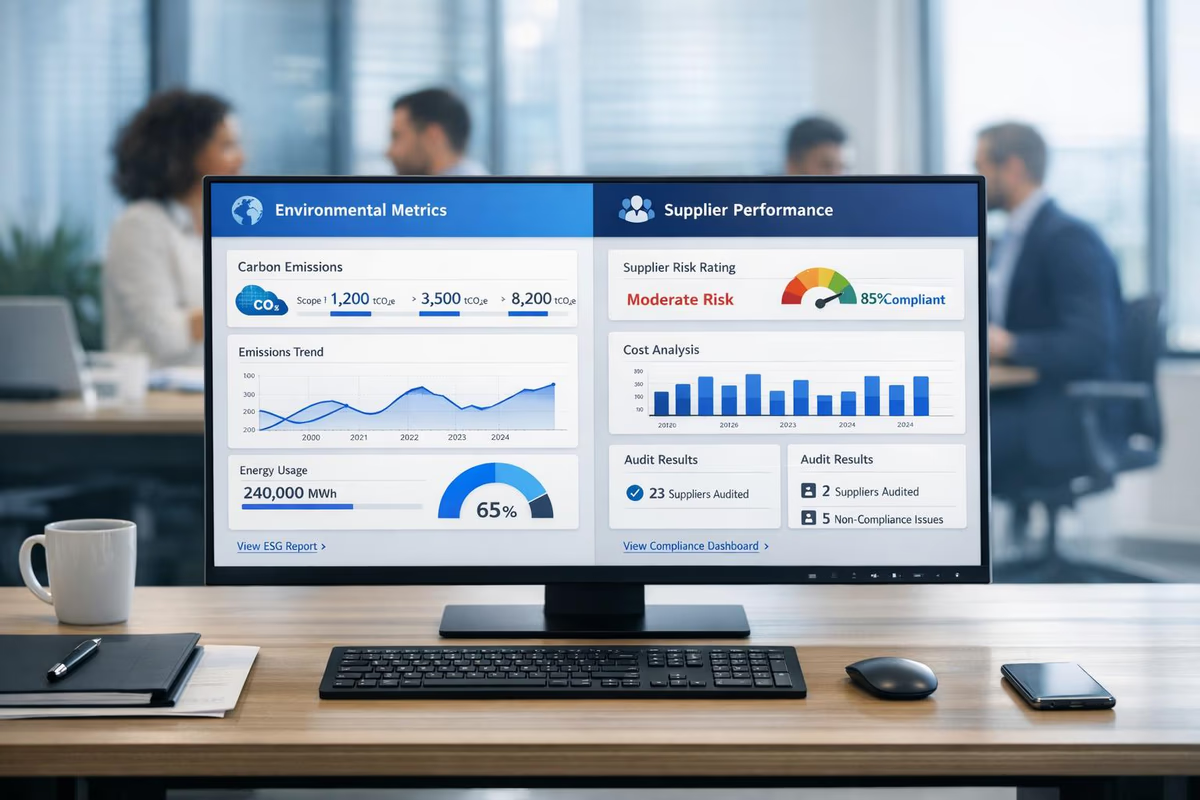
Supply chain ESG reporting is under pressure. Most companies struggle with poor supplier data, manual processes, and inconsistent standards, making compliance and accuracy difficult. These issues are critical as regulations like SECR and UK SRS demand precise reporting, especially for Scope 3 emissions.
Key Challenges:
- Data Gaps: Over-reliance on estimates instead of actual supplier data.
- Manual Processes: Spreadsheets and emails lead to errors and inefficiencies.
- Inconsistent Standards: Suppliers use varying metrics and frameworks, complicating consolidation.
- Weak Audit Trails: Limited validation and documentation increase audit risks.
Solutions:
- Gather primary vs secondary data for high-impact suppliers.
- Use centralised, automated tools to replace spreadsheets.
- Standardise reporting templates across suppliers.
- Implement validation checks and maintain clear audit trails. Following an ESG data collection checklist can help streamline these steps.
By addressing these errors, companies can improve reporting accuracy, reduce audit risks, and better meet regulatory demands.
Common Challenges in Supplier ESG Data Collection
Data Gaps and Incomplete Coverage
One of the biggest hurdles in ESG reporting is the lack of reliable supplier data. Many organisations rely on spend-based carbon accounting to estimate emissions, which often leads to shaky baselines. Bob Burgoyne from the Carbon Trust highlights this issue:
Emissions estimates are always that: estimates. Particularly for Scope 3 emissions, where most companies use spend as a proxy for real/actual supplier emissions... for others, it's markedly inaccurate.
When financial proxies replace primary data, the results can be inconsistent, making it tough to establish a dependable foundation for emissions tracking. This gap in data accuracy often snowballs into inefficiencies further down the line.
Fragmented Systems and Manual Processes
Another stumbling block lies in the outdated methods used to gather supplier ESG data. Many organisations still rely on spreadsheets and email surveys, which are not only time-consuming but also riddled with potential for errors. Finance teams often spend countless hours manually piecing together supplier data, only to face issues like version conflicts and missing information.
This lack of a centralised system leaves teams struggling to maintain version control or track updates effectively. The problem is compounded as sustainability reporting increasingly falls to finance teams, who are more accustomed to the precision of financial data. Without proper tools or integration, they’re left juggling multiple spreadsheets and reconciling conflicting figures, which not only increases the risk of mistakes but also limits the potential to scale these efforts.
Inconsistent Standards and Reporting Frameworks
A further challenge arises from the lack of uniformity in how suppliers report their data. Different suppliers use varying metrics, units, and emission factors, making it difficult to consolidate their information into a cohesive report. For instance, while some suppliers adhere to the Greenhouse Gas Protocol, others might follow ISO 14064 or no recognised standard at all.
This inconsistency means teams often spend more time converting units and reconciling different methodologies than actually analysing the data. Without standardisation, it becomes nearly impossible to compare supplier performance accurately or identify risks effectively. These discrepancies not only slow down the reporting process but also undermine the reliability of the overall ESG performance assessment.
Transforming ESG Data Collection across the Supply Chain - Webinar
Key ESG Data Collection Errors and How to Fix Them
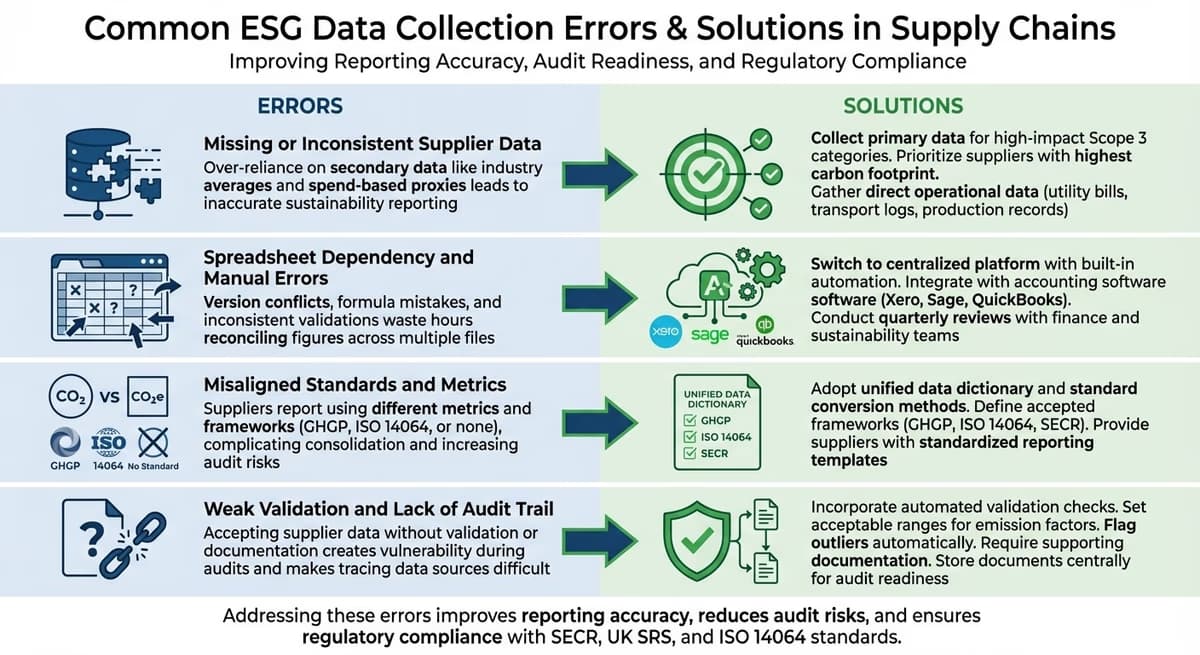
4 Common ESG Data Collection Errors and Solutions for Supply Chains
Error 1: Missing or Inconsistent Supplier Data
Relying too heavily on secondary data - like industry averages or spend-based proxies - can lead to reporting that doesn't accurately reflect actual sustainability efforts.
To address this, focus on collecting activity-based primary data for the Scope 3 categories with the most significant impact. Prioritise suppliers with the highest carbon footprint and gather direct operational data, such as utility bills, transport logs, or production records. For accounting firms assisting clients, tools like neoeco can simplify this process by mapping financial transactions to recognised emissions categories under frameworks like GHGP and ISO 14064. This reduces manual data conversions while ensuring compliance with audit-ready standards.
With data gaps addressed, let’s look at the inefficiencies caused by spreadsheet dependency.
Error 2: Spreadsheet Dependency and Manual Errors
Spreadsheets often lead to version conflicts, formula mistakes, and inconsistent validations, wasting hours on reconciling figures across multiple files.
Switch to a centralised platform with built-in automation and validation features. Choose platforms that integrate directly with accounting software like Xero, Sage, or QuickBooks to automatically pull transaction data. Conduct quarterly reviews with finance and sustainability teams to catch and resolve issues early.
Once manual errors are under control, the next hurdle is standardising supplier metrics.
Error 3: Misaligned Standards and Metrics
Suppliers often report using different metrics - some may use CO2, others CO2e, and reporting frameworks vary widely. These inconsistencies complicate consolidation, delay reporting, and increase audit risks.
To address this, adopt a unified data dictionary and standard conversion methods across your supply chain. Clearly define which frameworks - such as GHGP, ISO 14064, or national standards like SECR - you will accept, and provide suppliers with easy-to-follow reporting templates. As frameworks like CSRD and ISSB make sustainability reporting mandatory, standardisation will become increasingly critical. For more insights, explore how ISSB reporting integrates with financial strategies.
After standardisation, ensuring robust data validation is the next step.
Error 4: Weak Validation and Lack of Audit Trail
Accepting supplier data without thorough validation or proper documentation can leave organisations vulnerable during audits. Without a clear audit trail, tracing data back to its source becomes a challenge when assurance teams or regulators request evidence.
Incorporate automated validation checks into your data collection process. Set acceptable ranges for emission factors, flag outliers automatically, and require supporting documentation - like invoices or certificates - for all submissions. Store these documents centrally alongside the corresponding data to remain audit-ready, whether reporting under SECR, UK SRS, or preparing for future assurance requirements under standards like ISO 14064.
How Accounting Firms Can Improve ESG Data Collection
Using Finance-Integrated Tools
To streamline ESG data collection, firms should leverage their existing financial systems. By mapping transactions from platforms like Xero, Sage, or QuickBooks to established emissions categories under frameworks like GHGP and ISO 14064, firms can skip manual data entry, minimise errors, and automatically align supplier transactions with carbon reporting standards.
Tools such as neoeco integrate directly with financial ledgers, automatically categorising transactions into Scope 1, 2, and 3 emissions under recognised frameworks (GHGP, ISO 14064, SECR, UK SRS, ASRS 2). This eliminates the hassle of manual input and produces audit-ready reports. For a deeper dive into how this approach supports broader reporting strategies, check out how ISSB reporting integrates with financial systems.
While technology plays a significant role, assigning clear responsibilities across teams is equally critical for improving ESG data quality.
Creating Cross-Functional Ownership
ESG data collection often falters when roles and responsibilities are unclear. To address this, the Financial Reporting Council advises firms to document specific responsibilities for data producers, owners, coordinators, reporters, and validators.
"Identify the data producers and owners across the company for different data sets, and the coordinators, reporters and validators for a joined-up approach." – Financial Reporting Council (FRC)
Clearly defining these roles ensures accountability throughout the process. Involving internal audit teams from the outset and applying the same rigorous controls and approval processes used for financial data can help maintain consistency, even during staff transitions. Additionally, boards and senior leadership should receive training on how ESG data impacts strategic decisions and resource allocation.
Standardised processes further strengthen these efforts by reducing inconsistencies.
Standardising Processes and Templates
Integrated tools and clearly defined roles are most effective when paired with standardised processes. Ad hoc data collection often results in discrepancies, so firms should implement standardised ESG data templates. These templates should specify which metrics suppliers need to provide, the required format, and the reporting frequency. Aligning these templates with frameworks like GHGP, ISO 14064, and SECR ensures consistency in supplier reporting.
Regular audits, using standards such as ISO 14064 or SA8000, help verify the accuracy of supplier data. Firms can also encourage suppliers to improve their ESG practices by offering perks like bidding advantages or long-term contracts to those meeting high ESG standards. By treating ESG data collection as an ongoing process rather than a once-a-year task, firms can stay audit-ready and maintain high data quality.
Conclusion
The challenges and solutions discussed highlight one key takeaway: having reliable ESG data is crucial for making informed strategic decisions. Supplier ESG data isn't just about ticking compliance boxes - it plays a central role in shaping decisions across the supply chain. Issues like missing data, spreadsheet mistakes, and inconsistent frameworks can erode trust, increase costs, and make it harder to spot areas for improvement.
"High-quality data is critical to high-quality decision-making. Improving the systems and processes for the production of ESG data... will result in better decision-useful information." – Josephine Jackson, Chair, FRC ESG and Climate Group
This quote underscores the importance of strong data systems in enhancing ESG reporting and managing risks effectively. With ESG reporting responsibilities increasingly shifting from sustainability teams to finance and compliance departments, accounting firms are uniquely positioned to guide this transition. By using finance-integrated tools like those offered by neoeco, organisations can streamline their ESG reporting, eliminate errors, maintain secure audit trails and traceability, and produce compliance-ready reports that align with standards like GHGP, ISO 14064, SECR, and UK SRS.
Moving away from spreadsheets is a critical step. Adopting systems that prioritise continuous data quality improvement can prevent costly restatements. Standardised processes, clear accountability, and tools integrated with financial systems ensure ESG data achieves the same level of reliability as financial data.
FAQs
What is the best way for companies to collect primary ESG data from their suppliers?
Collecting primary ESG data - directly from your suppliers instead of relying on industry averages - is essential for precise and audit-ready reporting. To begin, assign clear responsibility for data collection, often to your sustainability or procurement team, and ensure it becomes a part of their KPIs. Then, map out your supplier network and carry out a materiality assessment to pinpoint high-impact suppliers. These are usually determined by factors such as spend, size, or exposure to ESG risks.
For these key suppliers, use standardised questionnaires or digital tools to gather specific metrics like energy usage, water consumption, or labour practices. Automation can be a game-changer here. Cloud-based ESG platforms are particularly helpful - they can align supplier transactions with recognised emissions categories (e.g., GHGP, ISO 14064, SECR, UK SRS), flag inconsistencies, and securely store all evidence in one place. This approach not only reduces manual errors but also ensures compliance with UK reporting standards and keeps your data up to date as regulations change.
By combining strong governance, a targeted supplier focus, standardised data collection methods, and automated tools, businesses can efficiently collect dependable ESG data to strengthen their Scope 3 emissions reporting.
Why should businesses use centralised platforms instead of spreadsheets for ESG reporting?
Centralised ESG platforms transform the reporting process by replacing cumbersome spreadsheets with a streamlined, cloud-based system. These platforms automatically validate and standardise data, eliminating common issues like formula errors, duplicate entries, and version-control mishaps. The result? More accurate, audit-ready reports without the manual headaches. Plus, they keep pace with evolving ESG regulations - whether it’s ISSB, CSRD, or SECR - so you don’t have to worry about manually updating compliance standards.
What’s more, these platforms integrate seamlessly with accounting tools like Xero, Sage, and QuickBooks. This direct connection allows ESG metrics to be linked to financial data quickly and efficiently. It not only saves time and cuts labour costs but also makes scaling reporting across multiple suppliers a breeze. The outcome is a reporting process that’s faster, more reliable, and fully compliant, leaving behind the inefficiencies of traditional spreadsheet workflows.
Why is it important to standardise supplier metrics for ESG reporting?
Standardising supplier metrics plays a crucial role in producing accurate and reliable ESG reports. When suppliers use the same definitions, units, and calculation methods, it becomes much easier to compile, verify, and align data with established frameworks like the Greenhouse Gas Protocol, ISO 14064, SECR, or UK Sustainability Reporting Standards. This approach eliminates inconsistencies often caused by manual processes or scattered spreadsheets, providing a clearer and more dependable picture of Scope 3 emissions - typically the largest contributor to a company's carbon footprint.
Consistency in metrics also helps reduce human error and avoids the expense of making corrections later. Automated validation tools can flag discrepancies instantly, ensuring the data is not only accurate but also ready for audits. Leveraging supplier-provided data wherever possible enhances traceability and precision. For suppliers with a smaller impact, secondary or estimated data can serve as a practical alternative. In the end, standardising metrics ensures ESG reports are uniform, compliant, and trustworthy for stakeholders.