Top Tools for Community Impact Reporting in 2025

Dec 24, 2025
Ledger-integrated tools are now essential for UK accountants to produce audit-ready carbon and social impact reports under tighter SECR and UK SRS rules.
In 2025, UK accountants face growing pressure to produce accurate, audit-ready sustainability reports due to stricter regulations like SECR, UK SRS, and ISSB. The challenge? Disorganised ESG data across multiple sources. Automated tools now help streamline reporting by integrating financial systems with sustainability metrics, reducing manual errors and ensuring compliance.
Here are the top tools for accountants managing carbon and community impact reporting:
neoeco: Links Xero, Sage, and QuickBooks data for carbon reporting. Supports SECR, UK SRS, and GHGP compliance. Pricing starts at £399/year.
True Impact: Focuses on social return on investment (SROI) for CSR programmes. Limited automation and no direct accounting integration.
Blackbaud Impact Edge: Tailored for charities but lacks UK-specific compliance and detailed automation features.
Benevity Reporting Suite: Tracks employee engagement and CSR metrics but doesn’t support carbon reporting or accounting integrations.
UpMetrics: Measures social ROI with custom indicators but relies on manual data entry.
Unit of Impact: Offers social value reporting, though public details are limited.
For UK accountants, neoeco stands out by integrating financial data directly, automating processes, and simplifying compliance. Free trials are available to test compatibility and ensure audit-ready results.
Quick Comparison
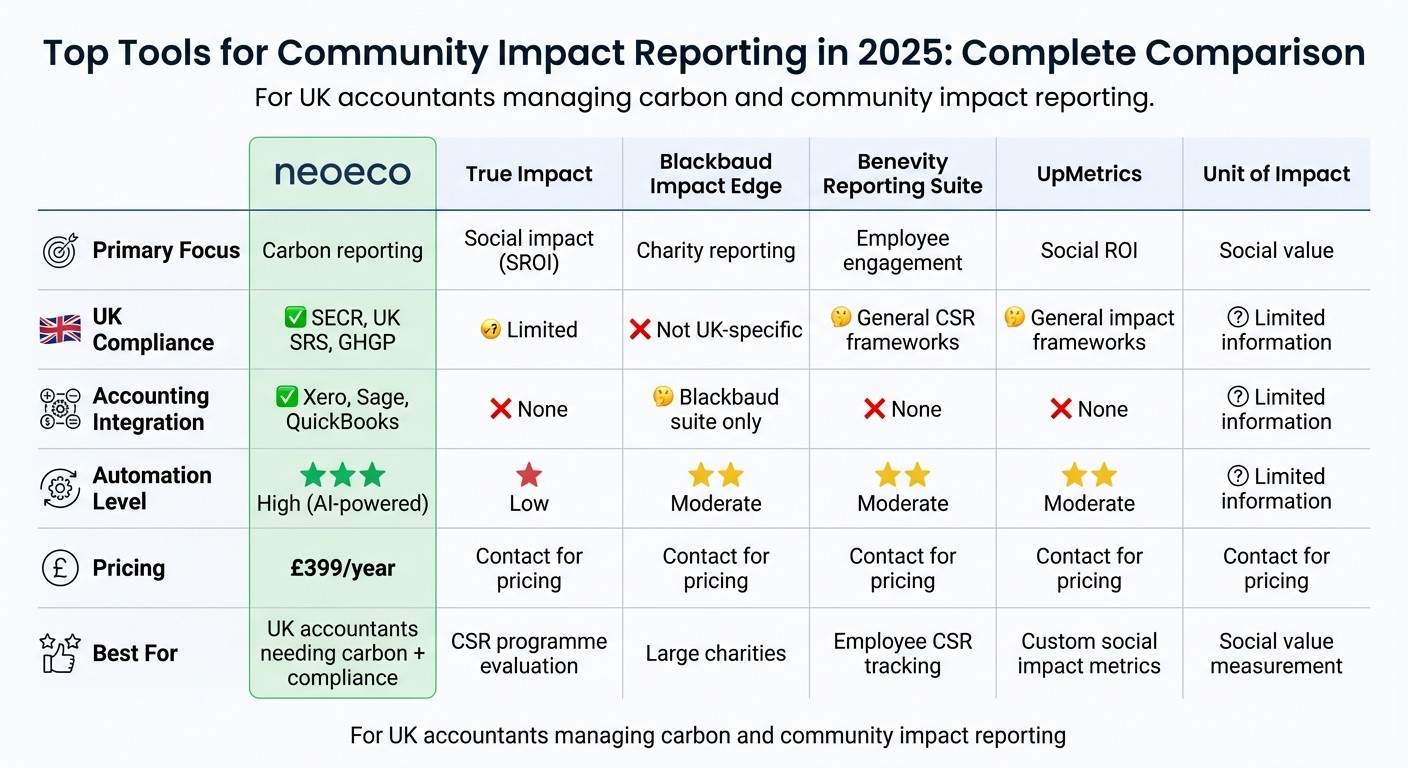
Tool | Focus | UK Compliance | Accounting Integration | Automation | Pricing |
|---|---|---|---|---|---|
neoeco | Carbon reporting | SECR, UK SRS, GHGP | Xero, Sage, QuickBooks | High (AI-powered) | £399/year |
True Impact | Social impact (SROI) | Limited | None | Low | Contact for pricing |
Blackbaud Impact Edge | Charity reporting | Not UK-specific | Blackbaud suite only | Moderate | Contact for pricing |
Benevity Reporting Suite | Employee engagement | General CSR frameworks | None | Moderate | Contact for pricing |
UpMetrics | Social ROI | General impact frameworks | None | Moderate | Contact for pricing |
Unit of Impact | Social value | Limited public information | Limited public information | Limited public information | Contact for pricing |
Choose a tool that fits your firm’s needs and ensures compliance while reducing manual effort.
Community Impact Reporting Tools Comparison 2025: Features, Compliance & Pricing
Social Impact Measurement and Reporting Tools and Best Practices
1. neoeco
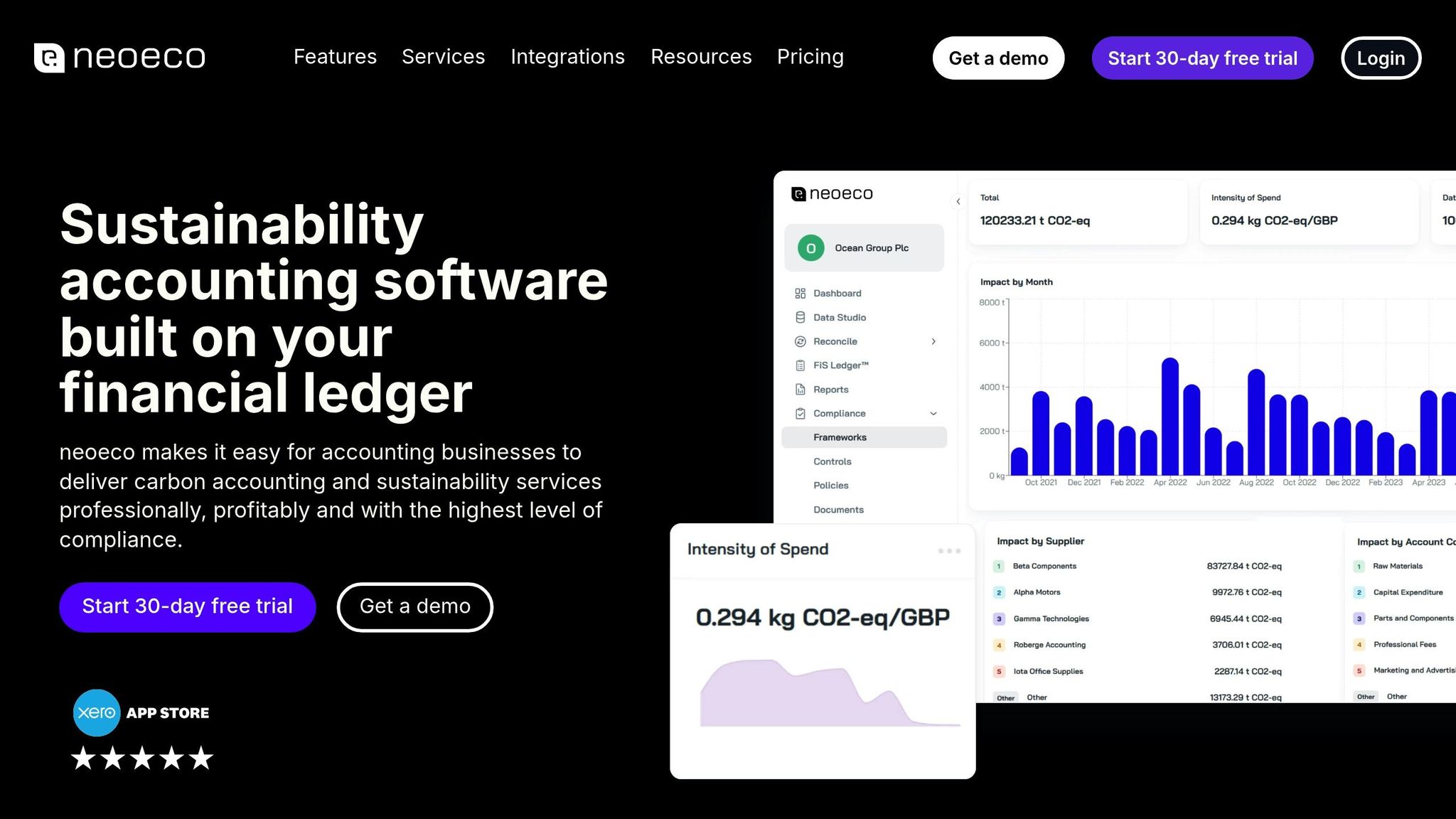
neoeco is a sustainability software designed specifically for UK accounting firms. Built on financial ledgers, it seamlessly integrates with Xero, Sage, and QuickBooks, automatically pulling transaction-level data. This ensures that every carbon calculation is directly traceable to its original financial record, making compliance straightforward and reliable. Its direct connection to accounting ledgers simplifies adherence to UK-specific regulations.
UK-Specific Compliance
neoeco delivers one-click compliance reporting tailored for SECR and UK SRS requirements. It also supports frameworks like GHGP and ISO 14064. Features like the Evidence Readiness Tracker and a centralised Policy and Evidence Hub ensure all supporting documentation is securely stored and ready for audits . Auditors can be granted read-only access through the platform, cutting down on time-consuming email exchanges during assurance processes. With an impressive 5.0-star rating on the Xero App Store, users highlight its "seamless" integration and describe it as an "end-to-end reporting solution built for accountants".
Integration with Accounting Software
The platform reads invoices, bank transactions, and supplier data without modifying any records. Using AI-powered matching, it links each transaction to the relevant activity vs spend-based carbon data . This level of ledger-grade traceability is particularly valuable for firms managing multiple clients, as every emission figure is tied directly to a specific financial entry. Such robust integration supports scalable automation, making it a standout tool for accounting professionals.
Automation and Scalability
neoeco employs advanced AI models to cross-check outputs and address data gaps. Firms can manage multiple client entities through a single dashboard, with automated weekly or monthly reporting . For UK accountants working with diverse client portfolios, this significantly reduces manual effort and streamlines compliance workflows.
Pricing starts at £34/month per company (billed annually) for the Standard Plan, which supports up to three users and includes one-click GHGP and SECR reporting. The Premium Plan, priced at £99/month, offers additional features such as LCA coverage, support for up to 10 users, and comprehensive audit packs. A 30-day free trial with full feature access is available, allowing firms to test the platform's ledger integration capabilities before making a commitment . The software also boasts 99.9% uptime and adheres to SOC2 and GDPR standards .
2. True Impact
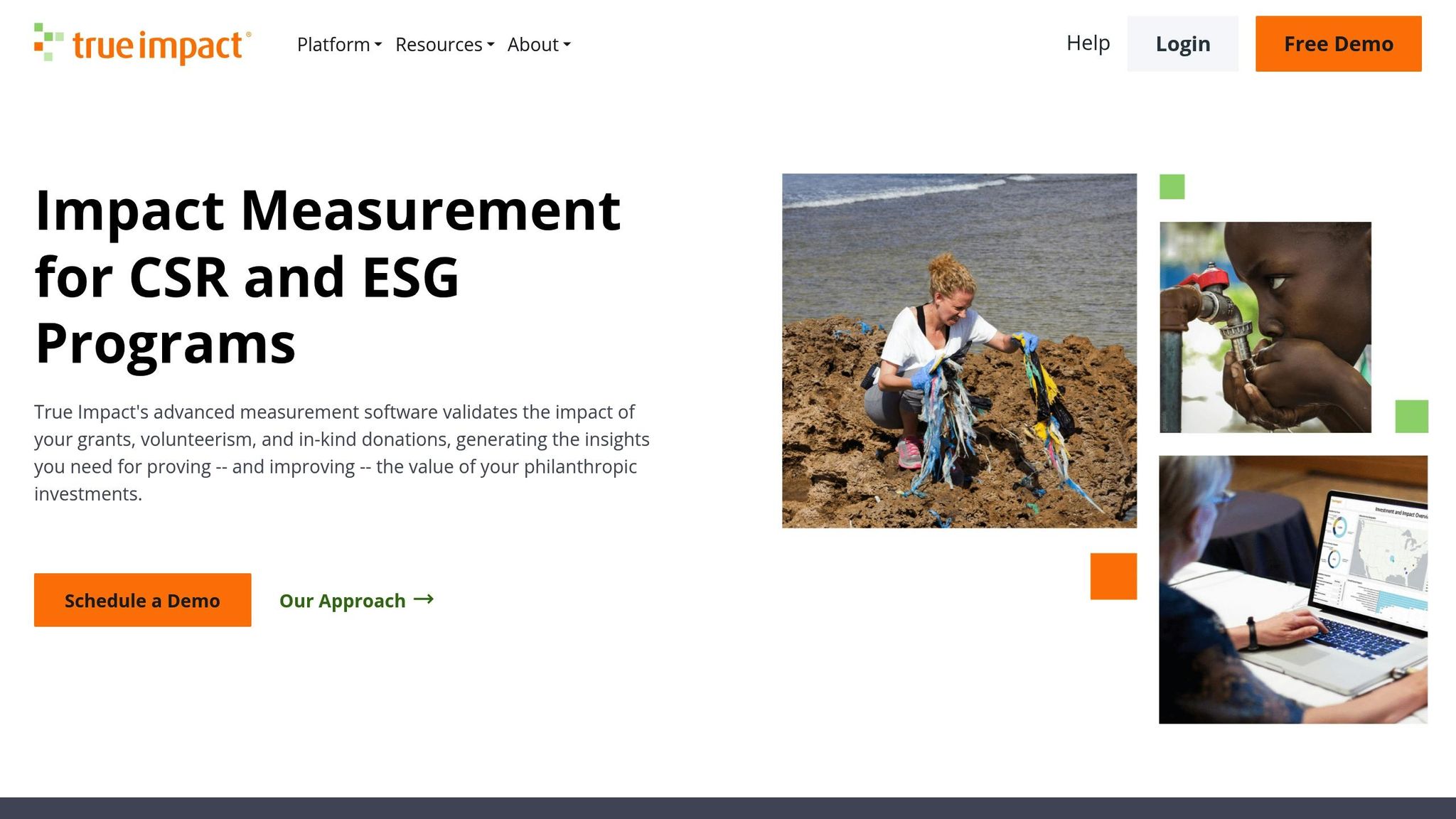
True Impact is a platform designed specifically to measure the social outcomes of CSR programmes and charitable foundations. Unlike tools that combine financial and environmental data, True Impact zeroes in on social impact. It evaluates metrics like grant allocations, volunteer hours, and community outcomes, helping organisations understand the social return on investment (SROI) from their community engagement efforts.
Community Data Sources
The platform gathers information from various sources, including grant disbursements, volunteer activity logs, and feedback from beneficiaries. This allows organisations to track how funds are being used in community projects and measure the results against defined social goals. By doing so, companies can refine their volunteer programmes and efficiently oversee charitable trusts.
True Impact’s emphasis on detailed social metrics provides a specialised perspective on community impact, complementing other reporting tools.
3. Blackbaud Impact Edge
Blackbaud Impact Edge is set to play a role in community impact reporting in 2025. However, with limited documentation currently available, detailed insights into its features are scarce. Organisations seeking up-to-date information on its capabilities - like validating social impact data for reporting and automation - should refer directly to official Blackbaud resources.
4. Benevity Reporting Suite
While many platforms focus on integrating carbon and social impact data, the Benevity Reporting Suite takes a slightly different route, concentrating on social and employee engagement metrics.
Benevity Reporting Suite is designed to track corporate social responsibility (CSR) metrics and employee engagement data. It’s particularly effective for monitoring workplace giving programmes and community investments. The platform consolidates data from volunteering efforts and grantmaking activities, but its core strength lies in supporting employee-focused community initiatives rather than providing detailed environmental reporting.
Community Data Sources
Benevity excels in tracking employee volunteer hours and skills-based volunteering efforts. For grantmaking, it provides insights into application statuses, disbursement amounts, and information about recipient organisations. This makes it a valuable tool for businesses prioritising employee-driven community contributions. However, its focus on social metrics means it lacks the environmental or carbon-reporting capabilities that many UK organisations require.
UK-Specific Compliance
The platform is tailored for social impact reporting and does not support carbon reporting compliance. This limitation means companies needing compliance with frameworks like SECR or UK SRS must pair Benevity with a dedicated sustainability accounting tool. For organisations looking to combine social and environmental reporting seamlessly, a financially-integrated sustainability management platform would be a better fit.
Integration with Accounting Software
Currently, there’s no evidence of direct integration with Xero or Sage, which may require manual reconciliation of financial and impact data. For accounting firms managing both community impact and carbon reporting services, this lack of integration could result in extra administrative work and potential risks to data accuracy.
5. UpMetrics
UpMetrics takes a distinctive approach to reporting by zeroing in on community outcomes. It helps organisations evaluate the effectiveness of their programmes and calculate social ROI, making it easier to showcase the tangible impact of their community projects. This emphasis on outcomes is supported by its strong data collection approach, which is worth a closer look.
Community Data Sources
To measure community outcomes and social ROI, UpMetrics gathers both qualitative and quantitative data. This includes insights on community relationships, diversity and inclusion efforts, and workforce practices. Data is collected through tailored surveys, interviews, or even manual inputs, ensuring organisations get a comprehensive view of their initiatives.
6. Unit of Impact
Unit of Impact is a platform designed to help organisations measure and report on social value and community outcomes. As public details about its framework and features are scarce, reaching out to the provider directly is recommended for a clearer understanding of how it works. This tool adds another option for organisations looking to strengthen their approach to community impact reporting tools.
Tool Comparison Table
The table below breaks down six tools designed for UK accountants managing community impact reporting. It evaluates how each platform handles key aspects like data sources, compliance with UK frameworks, integration with accounting software, automation features, and pricing (in GBP).
Tool | Community Data Sources | UK-Specific Compliance | Integration with Accounting Software | Automation and Scalability | Pricing (GBP) |
|---|---|---|---|---|---|
neoeco | Financial ledger transactions (Xero, Sage, QuickBooks) | SECR, UK SRS, GHGP, ISO 14064 for transport emissions | Direct read-only ledger integration with Xero, Sage, QuickBooks | AI-powered transaction mapping, audit-ready reports, real-time dashboards | £399/year (Carbon-Only) |
True Impact | Survey data, programme outputs, beneficiary feedback | Limited UK-specific frameworks | Manual CSV uploads, no direct accounting integration | Limited automation for survey analysis | Contact for pricing |
Blackbaud Impact Edge | Donor and grant management data, programme metrics | General charity reporting, not UK-specific | Integration with Blackbaud suite only | High scalability for large charities; limited automation for smaller organisations | Contact for pricing |
Benevity Reporting Suite | Corporate giving, volunteering, employee engagement data | General CSR frameworks, not UK-specific | Limited integration with HR systems; no accounting software | Strong automation for corporate programmes; not optimised for SME budgets | Contact for pricing |
UpMetrics | Custom indicators, stakeholder surveys, programme data | General impact frameworks (SDGs, IRIS+), not UK-specific | Manual data entry; no direct accounting integration | Moderate automation for impact measurement and visualisation | Contact for pricing |
Unit of Impact | Social value and community outcomes data | Limited public information on UK compliance | Limited public information on integrations | Limited public information on automation | Contact for pricing |
The comparison highlights the strengths and limitations of each tool when it comes to community impact reporting. For UK accountants, neoeco stands out with its direct integration with Xero, Sage, and QuickBooks, simplifying data collection and enabling audit-ready carbon metrics. This eliminates the need for manual data entry, reducing administrative effort and ensuring accurate reporting. This is particularly critical as firms assess the financial impact of carbon risk.
As Alyssa Zucker, Senior Industry Principal, Carbon at Workiva, explains: "Choosing a solution with built-in governance and controls will provide businesses with the transparency and accuracy needed to ensure carbon reporting is audit-ready."
For firms beginning their carbon accounting journey, neoeco's £399 annual plan offers a straightforward entry point with templates ready for GHGP and SECR compliance. Other tools, however, require contacting vendors for pricing, which can slow down the decision-making process. Additionally, many platforms depend on manual uploads, increasing both workload and the potential for errors during audits.
To ensure the best fit, consider testing free trials to verify smooth data integration. Opt for platforms that offer detailed audit trails covering all data, assumptions, and calculations - these features are essential for simplifying independent verification. Such capabilities are key to achieving efficient and compliant sustainability reporting.
Conclusion
Community impact tools simplify compliance and tackle data inefficiencies for UK accountants. By connecting directly to financial ledgers, these platforms eliminate the need for manual data entry. They also offer audit-ready features, including evidence hubs and read-only auditor access, helping firms navigate regulatory scrutiny and avoid accusations of greenwashing.
When choosing a reporting tool, focus on the importance of high-quality, compatible data. Look for software that tracks emissions across all scopes - direct emissions (Scope 1), indirect energy use (Scope 2), and value chain impacts (Scope 3). Tools that integrate seamlessly with popular ERP systems like Xero, Sage, or QuickBooks can save time and prevent duplicated efforts.
Adopting these tools early can expand your role as an advisor, enabling you to guide clients on energy efficiency, sustainable practices, and net-zero strategies. For example, neoeco offers a £399 per annum plan that includes templates for GHGP and SECR compliance. With the UK government aiming to cut emissions by 81% by 2035, early adopters stand to gain a competitive edge.
Make use of free trials to ensure smooth integration and reliable, audit-ready data trails. Focus on achieving measurable benefits such as reduced risks, regulatory compliance, and improved operational efficiency.
Stay informed about updates on how to align ESG data with ISSB and financially-integrated sustainability management to keep your firm aligned with evolving standards. Ultimately, choose a tool that aligns with your clients' needs and delivers audit-ready results from the outset. The right tool can help you achieve compliance while advancing strategic sustainability goals.
FAQs
How does neoeco help accounting firms comply with UK sustainability regulations?
neoeco streamlines compliance with UK sustainability regulations by embedding ESG data directly into clients’ financial ledgers. It automatically aligns transactions with recognised emissions categories under frameworks like SECR, UK SRS, and ASRS, ensuring precision and adherence to regulatory standards.
By leveraging automation and AI-powered insights, neoeco removes the hassle of spreadsheets and manual data handling. It produces audit-ready reports that are accurate and meet compliance needs, empowering accounting firms to handle carbon and sustainability reporting with confidence while prioritising professional and profitable service delivery.
What are the benefits of linking accounting software with sustainability reporting tools?
Integrating accounting software with sustainability reporting tools creates a centralised and reliable hub for managing both financial and environmental data. By connecting directly to platforms like Xero, Sage, or QuickBooks, these tools automatically sort transaction data into established emissions frameworks such as the GHG Protocol, ISO 14064, and SECR. This removes the need for manual spreadsheets, ensuring reports are accurate, audit-ready, and aligned with standards like ISSB, CSRD, and UK-specific regulations.
This seamless connection not only saves valuable time but also boosts data precision and reliability. It provides real-time insights, enabling businesses to forecast emissions, establish reduction targets, and evaluate financial implications. By simplifying workflows, it fosters collaboration between finance, sustainability, and compliance teams, helping organisations quickly produce polished, branded reports that can make an impression in a competitive market.
Why is automation crucial for improving community impact reporting?
Automation is redefining community impact reporting by removing the need for manual tasks like spreadsheets and data entry, which are often prone to mistakes. By pulling transaction-level data directly from financial systems, automated tools ensure precision and compliance with strict UK regulations, such as SECR and CSRD. This minimises the risk of errors and provides dependable, audit-ready data.
Beyond improving accuracy, automation dramatically accelerates the reporting process. Tasks like data collection, validation, and formatting are handled automatically, allowing accountants to produce polished reports in minutes rather than days. Advanced tools, including AI-driven modelling, make it easy to perform quick scenario analyses and compliance checks, freeing up valuable time for more strategic advisory roles.
Platforms like neoeco work seamlessly with popular UK accounting software, such as Xero and Sage, delivering finance-grade carbon data that aligns with regulatory requirements and client needs. This approach makes reporting faster, more reliable, and scalable for firms of any size.